How local businesses can build backlinks that matter

On this page · 1 of 6 ⌄
- Key takeaways
- What is link building and why does it matter for local SEO?
- Building local backlinks: strategies that work
- Free and low-cost link building for local businesses
- Local citations
- Technical considerations: quality, relevance and best practices
A sponsor logo on the local rugby club's website and a mention in the town paper are both backlinks. For local SEO, those are exactly the kinds of links you want: mentions from sources tied to your area, such as local news sites, chambers of commerce, community groups and directories that people in your town actually use.
Those links help Google understand how relevant and prominent your business is in a particular place. But there's a simpler way to think about it.
Whenever you're getting a backlink from another website, ask yourself: "If Google didn't exist, would I still want this link?" If the answer is no, it's probably a bad link. And that's the principle running through this whole article.
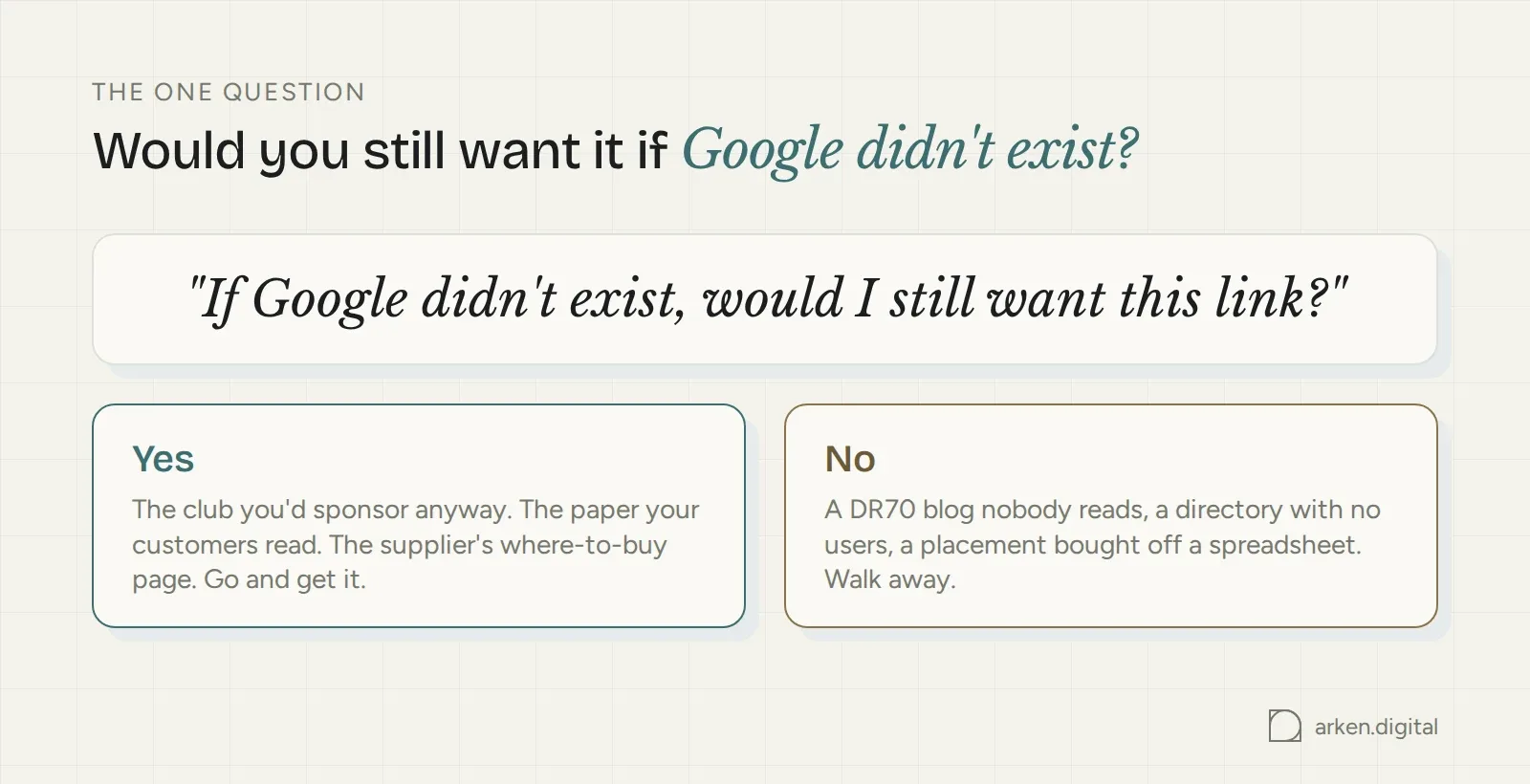
Local link building isn't about collecting the biggest authority scores you can find. It's about getting mentioned in the places that matter to your business, your industry and the people who can actually buy from you.
Key takeaways
- Claim the core listings first. As of early 2026, Google Business Profile, Apple Business Connect and Yelp all allow free claiming and verification. Yell's free listing covers name, address and phone only.
- Keep your contact information accurate where it matters. Your name, address and phone number need to be correct on the sites customers actually use. Chasing a ten-year-old address on a dead website nobody visits isn't a good use of your time.
- Prioritise geographic and topical relevance over authority scores. A locally relevant link from a site with real readers is worth far more than a big number in an SEO tool.
- If you'd still want the link with Google switched off, you're probably looking in the right place.
What is link building and why does it matter for local SEO?
Before getting into tactics, it's worth being clear about what a backlink actually is and what it does for a business selling to people within driving distance. The mechanics are simple. The local-search implications are where it gets useful.
Understanding link building basics
Your logo on the junior football club's sponsors page is a backlink. So is your entry on a supplier's where-to-buy list, a text mention in an article, or an image that links through to your site.
Links do two jobs. First, they act as a ranking signal. Google has specific documentation around link attributes such as rel="nofollow" and rel="sponsored", which it tells website owners to use when they don't want a link treated like a normal editorial link.
That's what Google says. What Google says and what happens in the search results aren't always the same thing: nofollow and sponsored links absolutely can pass ranking benefit. We've seen it. That doesn't mean ignoring Google's rules or deliberately mislabelling paid links. It means you shouldn't look at a perfectly good local sponsorship or directory link and dismiss it because an SEO tool tells you it's nofollow.
Second, links send real people. A mention on a local news site or popular community website can bring enquiries directly, whether it moves a ranking or not, and for a local business that's easy to underrate. A link that's already sending you enquiries has earned its keep before you start worrying about what Google thinks of it.
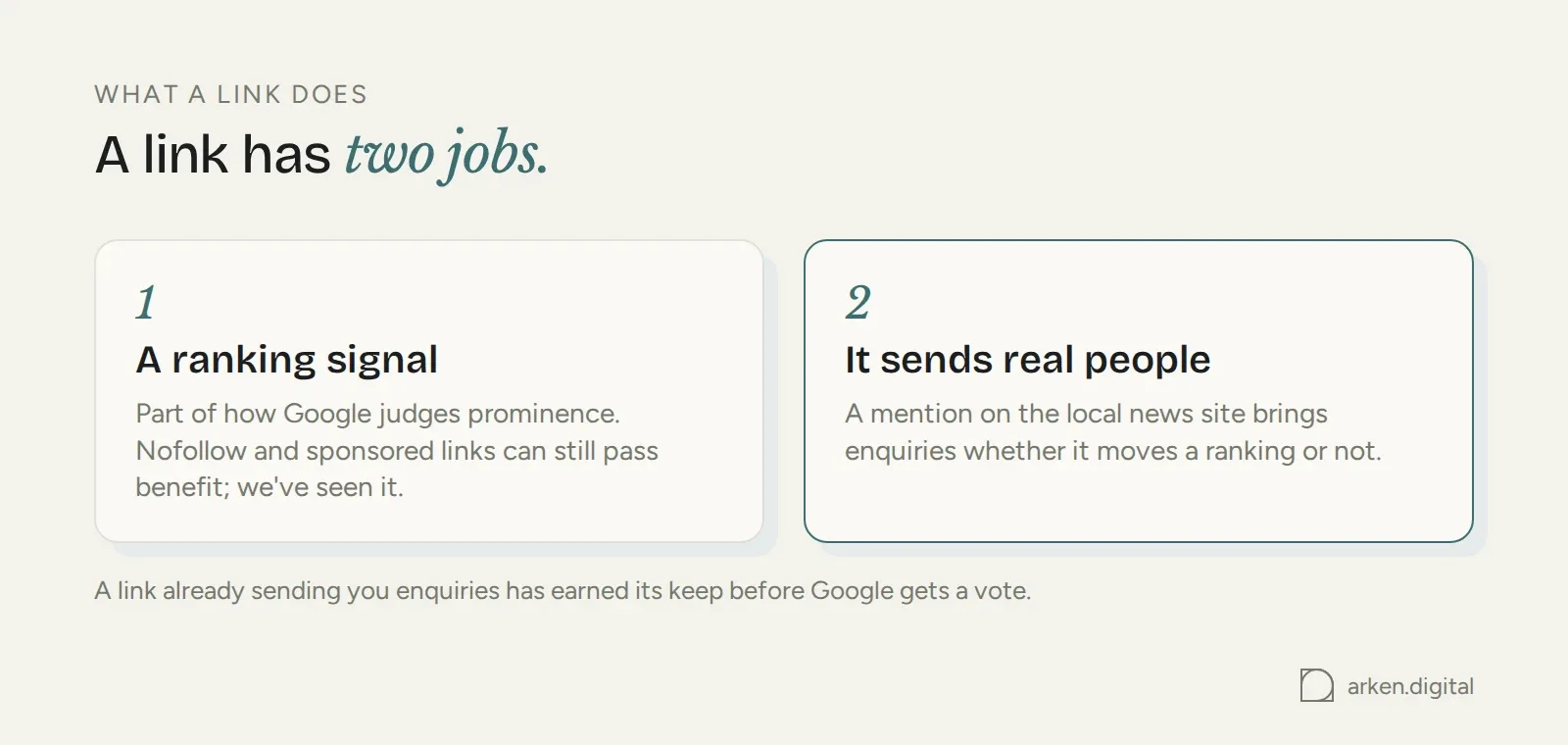
And that's why relevance matters more than a made-up authority score.
Does link building still work in 2026?
Yes. Google's own guidance on how local results are ranked says they're based primarily on relevance, distance and prominence. Prominence is partly informed by information Google finds across the web about your business, including links.
Google has adjusted local ranking weightings before. The Vicinity update in December 2021 increased the weight of proximity, but the three named factors have stayed in the documentation.
Links aren't the first lever we'd pull, though. Distance is largely set by your address, and if your Google Business Profile is half finished and you've got four reviews, sorting those things out will move the needle faster than spending the next three months chasing backlinks. Get the profile right. Get reviews coming in consistently. Then build prominence.
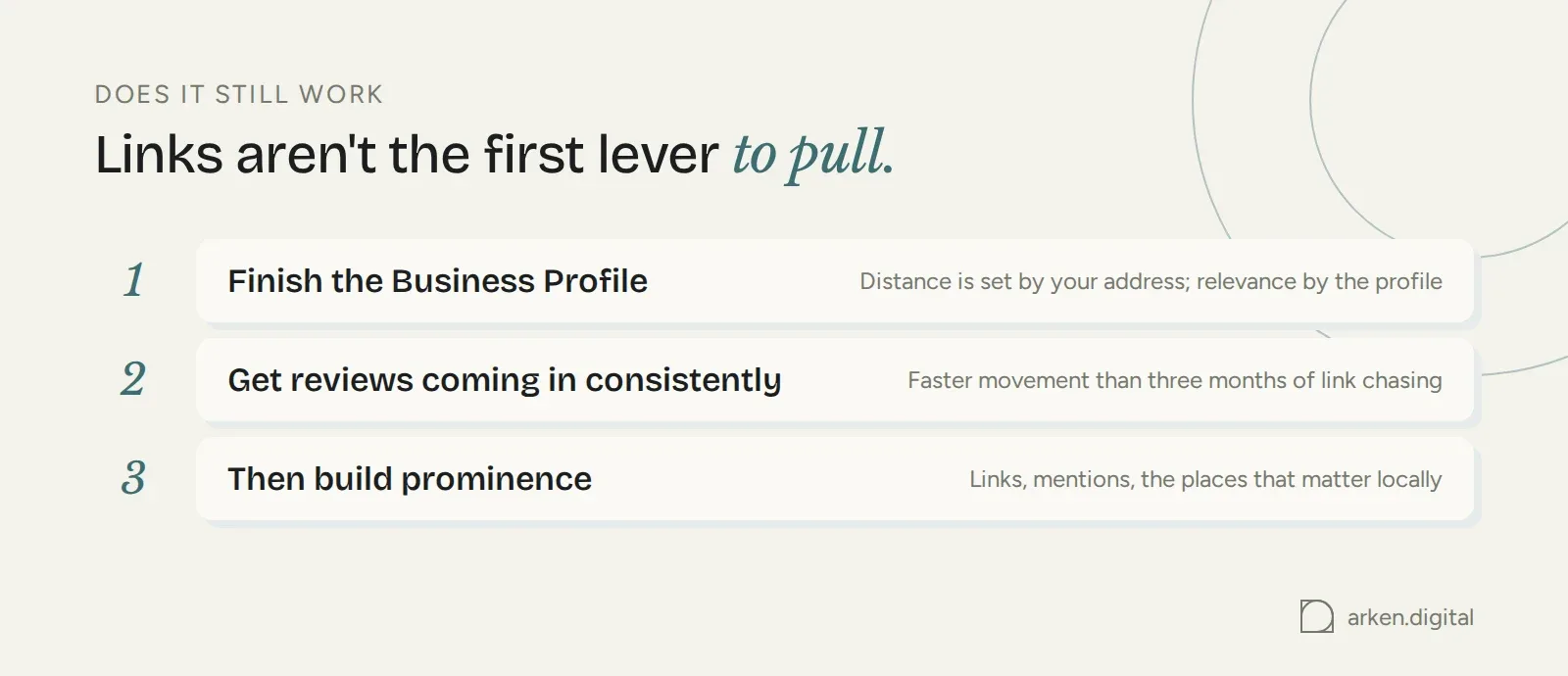
What has changed is where mentions can appear. AI overviews in search, plus assistants such as ChatGPT and Gemini, increasingly summarise information rather than just presenting ten blue links, which gives mentions another job to do.
An unlinked mention can still be worth having anyway. If your regional paper writes about you and sends three enquiries, you're not going to complain because the journalist forgot the hyperlink. You can always email them afterwards and ask them to add it.
Building local backlinks: strategies that work
The best local link-building tactics aren't particularly clever, which is a good thing. Some take an afternoon. Others take a few months of relationships and actual involvement in the area. All of them come back to the same principle: you're looking for websites with a genuine connection to where you work or what you do.
What makes local backlinks different?
One of the worst instincts in link building is opening an SEO tool, sorting a list by Domain Authority, Domain Rating or Authority Score and assuming the biggest number means the best link. Please don't do this. Those are third-party metrics. Google isn't sitting there deciding whether your local rugby club deserves to link to you because Ahrefs hasn't given it a sufficiently impressive DR.
For local search, geographic and topical relevance matter more. A plumber in a mid-sized town gets more out of a link from the local newspaper's business pages, or from a Trading Standards Buy With Confidence listing vetted through the participating local authority, than from some generic high-scoring blog that doesn't know where the town is.
There are two reasons. Google is trying to work out which businesses are prominent in a particular place, and the people reading genuinely local websites are the same people who can actually become customers.
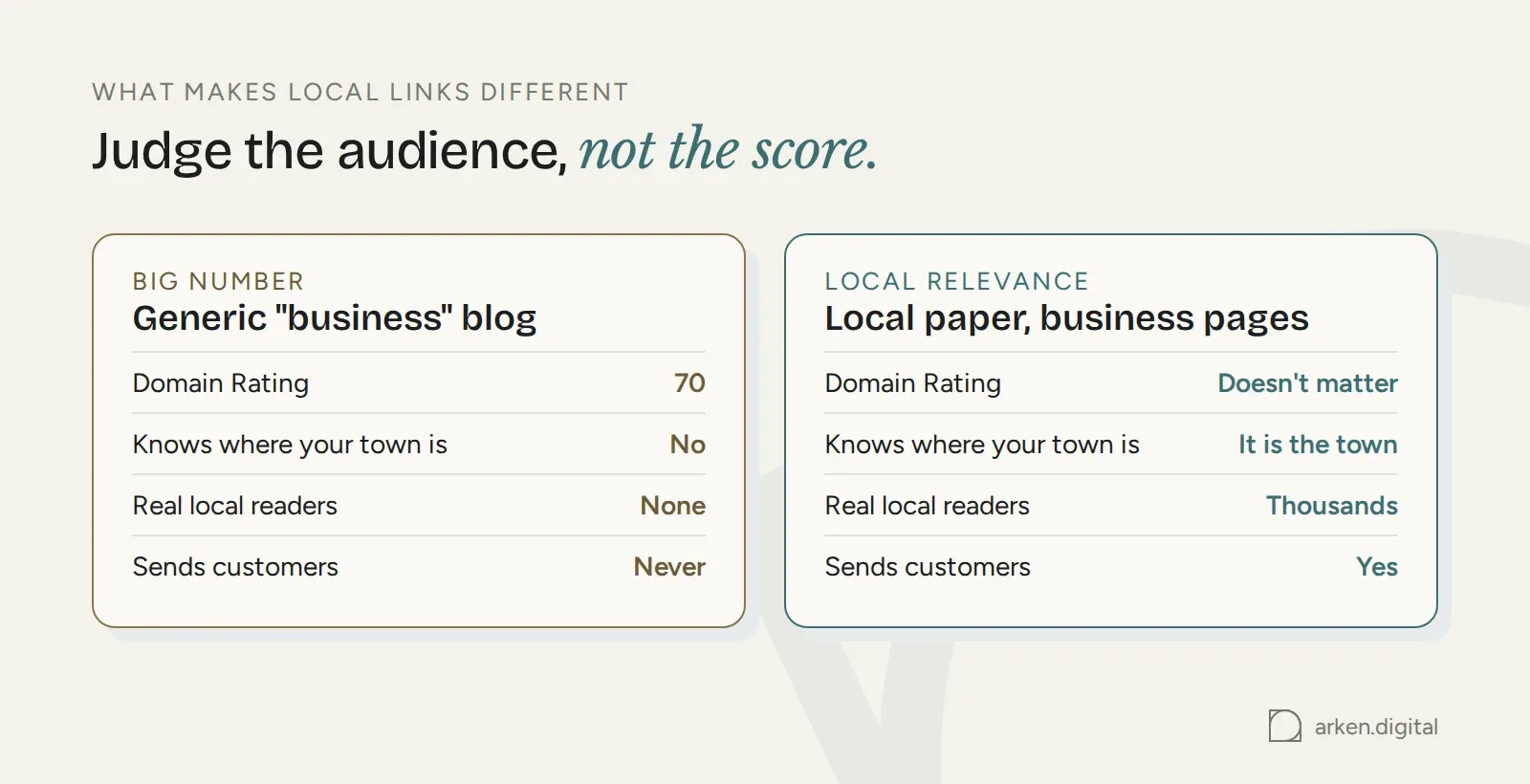
It also means your target list is manageable. You don't need a thousand backlinks. You need to find the directories, clubs, schools, news outlets, suppliers, community organisations and trade bodies connected to your patch.
Search "[town] sponsors", "[town] directory" and your trade plus the town name. Look through Google Maps for clubs, schools and community venues inside your service area. Then run two or three competitors through a backlink tool and see which local domains appear repeatedly. That's enough to start.
Directories
Directory listings are the lowest-effort place to begin. You control the submission, there's no pitching, and most can be done in one sitting.
Beyond the core listings, look for regional business directories, "best of" lists run by local media, and member directories on trade association sites. Trade association listings are particularly useful because they connect what you do with where you do it.
But don't take that as an instruction to submit your business to every directory you can find. Most directories offer little to no value. If nobody uses it, it has no relevance to your industry and its only apparent purpose is giving businesses another backlink, leave it alone.
Directories that verify your name, address and phone number are doing a slightly different job from editorial links. We'll come back to those properly under local citations.
Sponsorships
Sponsorships are one of the most dependable ways for a local business to earn genuinely relevant links. Junior football and rugby clubs, school fairs, village fetes, amateur dramatics groups, charity fun runs and food festivals all need money. Most have websites. Most have sponsor pages. And most are perfectly happy to mention the businesses helping to fund them.
Google's spam policies say that links attached to sponsorships should carry rel="sponsored" or nofollow because money has changed hands. Follow the rules, but don't confuse that with the idea that the link suddenly has no SEO value. As covered above, sponsored links can still pass ranking benefit, and the sponsorship itself puts your business in front of local people either way.
The cost is the donation or kit money, not an SEO fee. Ask upfront whether the sponsor page links out because some sites use logos without links. If it doesn't, ask for one. You're paying to appear on the page, so it's a perfectly reasonable request.
Stick to organisations you'd support anyway. If you're a Bristol business sponsoring a club in a town 150 miles away purely because its website has a big authority score, you're not doing community marketing. You're buying a link and dressing it up.
Local PR
Local PR works because local publications need local stories. They don't want a press release announcing your ongoing commitment to customer excellence. Nobody wants to read that. They want something happening in their patch.
You're taking on four apprentices. You're opening a second site. You've fixed something after a storm. You're running a free clinic for a community group. You've been trading for fifty years. That's a story.
Local journalists also have articles to produce every day. If you've got something genuinely interesting and you make it easy for them to turn it into a piece, you're helping them do their job. So pitch short: two or three sentences explaining what happened and why somebody living locally should care, a usable quote, and a decent photograph. Don't send seven paragraphs of company history and expect the journalist to dig the story out of it.
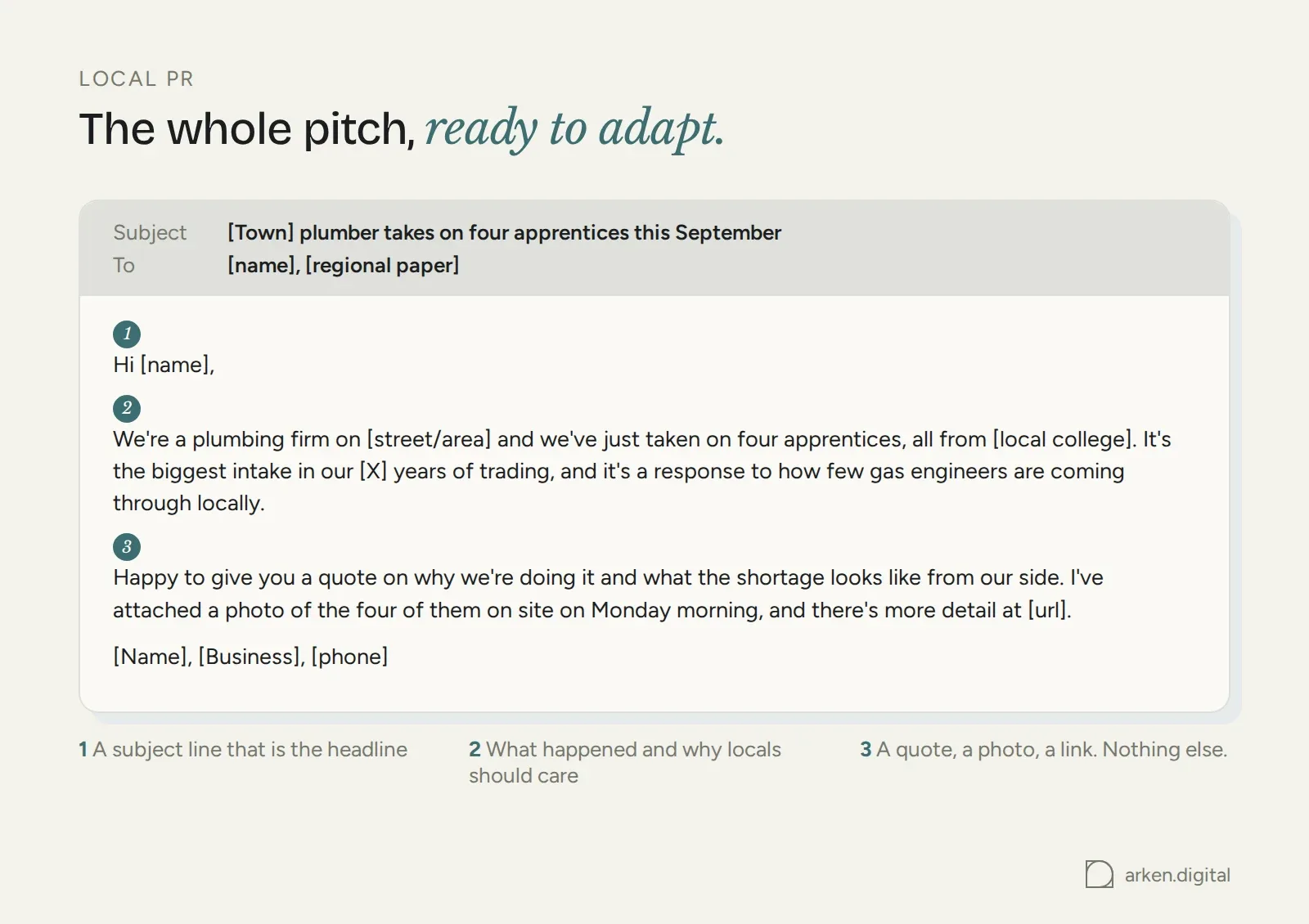
Here's the whole thing, ready to adapt:
Subject: [Town] plumber takes on four apprentices this September Hi [name], We're a plumbing firm on [street/area] and we've just taken on four apprentices, all from [local college]. It's the biggest intake in our [X] years of trading, and it's a response to how few gas engineers are coming through locally. Happy to give you a quote on why we're doing it and what the shortage looks like from our side. I've attached a photo of the four of them on site on Monday morning, and there's more detail at [url].[Name], [Business], [phone]
Build a sensible target list: your regional daily and weekly papers, hyperlocal news sites and community Facebook pages, plus trade press covering your sector.
Timing helps too. Seasonal angles, local anniversaries and stories connected to something the publication is already covering will land more often than a random pitch with no reason to run now. And if the coverage goes live without a link, email the journalist and ask them to add one.
Partnerships
Most businesses already have relationships that could produce links. They just haven't thought about them that way. Suppliers, installers, accountants, manufacturers and other local businesses serving the same customers are the obvious starting point.
Suppliers and manufacturers often have an "approved installer" or "where to buy" page. If you qualify and you're not listed, ask. Non-competing businesses serving the same audience can also recommend each other where it makes sense, and co-hosted events or genuine joint offers give both sides something worth talking about. That's a better reason for a link than a pointless "you link to me and I'll link to you" arrangement.
Start with people who already know your work. Those are the easiest yeses you'll get.
Guest posts
Guest posting isn't dead. Bad guest posting deserves to be.
Writing a genuinely useful article for a site with a real local audience can still be worthwhile: regional business magazines, chamber of commerce blogs, community news sites, trade association member blogs, a local university's careers pages. Real readers. Real editorial standards. An editor who'll tell you no if the idea is rubbish.
That's a different world from searching "guest posting service" and buying placements from a spreadsheet. Those services usually sell the same thing: websites with an impressive-looking Domain Authority, Domain Rating or Authority Score, barely any meaningful traffic, and almost no connection to your industry. Exactly what we don't want.
Worst case, you create a penalty risk. More commonly, absolutely nothing happens. You've paid for a backlink that brings no customers and no ranking benefit. You might as well light the money on fire.
If you're pitching a legitimate site, pitch the idea first rather than sending a finished article. Tell the editor what their readers get from it. Keep any link relevant to the piece and write anchor text that belongs naturally in the sentence. One placement on a website your customers actually read beats fifty links on websites nobody reads.
Building natural links through locally useful content assets
Outreach stops working when you stop doing it. A genuinely useful content asset can keep picking up links afterwards.
The important bit is making something specific enough to your area that other people actually need to reference it: a plain-English guide to planning constraints in your borough, a yearly cost breakdown for a common job in your region, a map showing where a service is and isn't available locally, or a calendar of trade events in the county. These pages earn links because they're useful things to point at.
Don't turn that into "link bait" for the sake of it. If the page wouldn't be useful without the backlink opportunity, you've already failed the Google-doesn't-exist test.
Give it a push when it goes live. Email community groups, local journalists and association staff who'd genuinely find it useful, then leave it to do its job.
Free and low-cost link building for local businesses
You don't need a massive link-building budget to make progress locally. A lot of the best opportunities cost nothing except a bit of time, and when you do spend money, you should know exactly what you're buying.
Getting backlinks without spending money
Start with the core listings. Google Business Profile, Apple Business Connect and Yelp cost nothing to claim and verify. Get those sorted first.
Then set up alerts for your business name. Google Alerts is free. When a website mentions you without linking, email whoever wrote the piece and ask whether they'll add the link. It's a small request, and you've already earned the mention.
Testimonials are another easy opportunity. Suppliers, software vendors and trade bodies all need genuine customer quotes for their websites. If you've got something worthwhile to say, send them a specific, honest testimonial. Many will credit it back to your business.
Get involved in local online communities too. Your town's subreddit, local Facebook groups and Meetup.com groups tied to your sector can all put you in front of relevant people. But actually participate. Don't join a group, dump your URL into the first thread you see and disappear. Moderators recognise drive-by promotion, and so does everybody else.
Two other easy wins: make sure trade associations you're already paying for actually list you, and check whether suppliers who mention your business link to your site rather than just naming you.
Understanding link building costs
There's no fixed price for local link building because there isn't one thing called "a backlink" that you go out and buy.
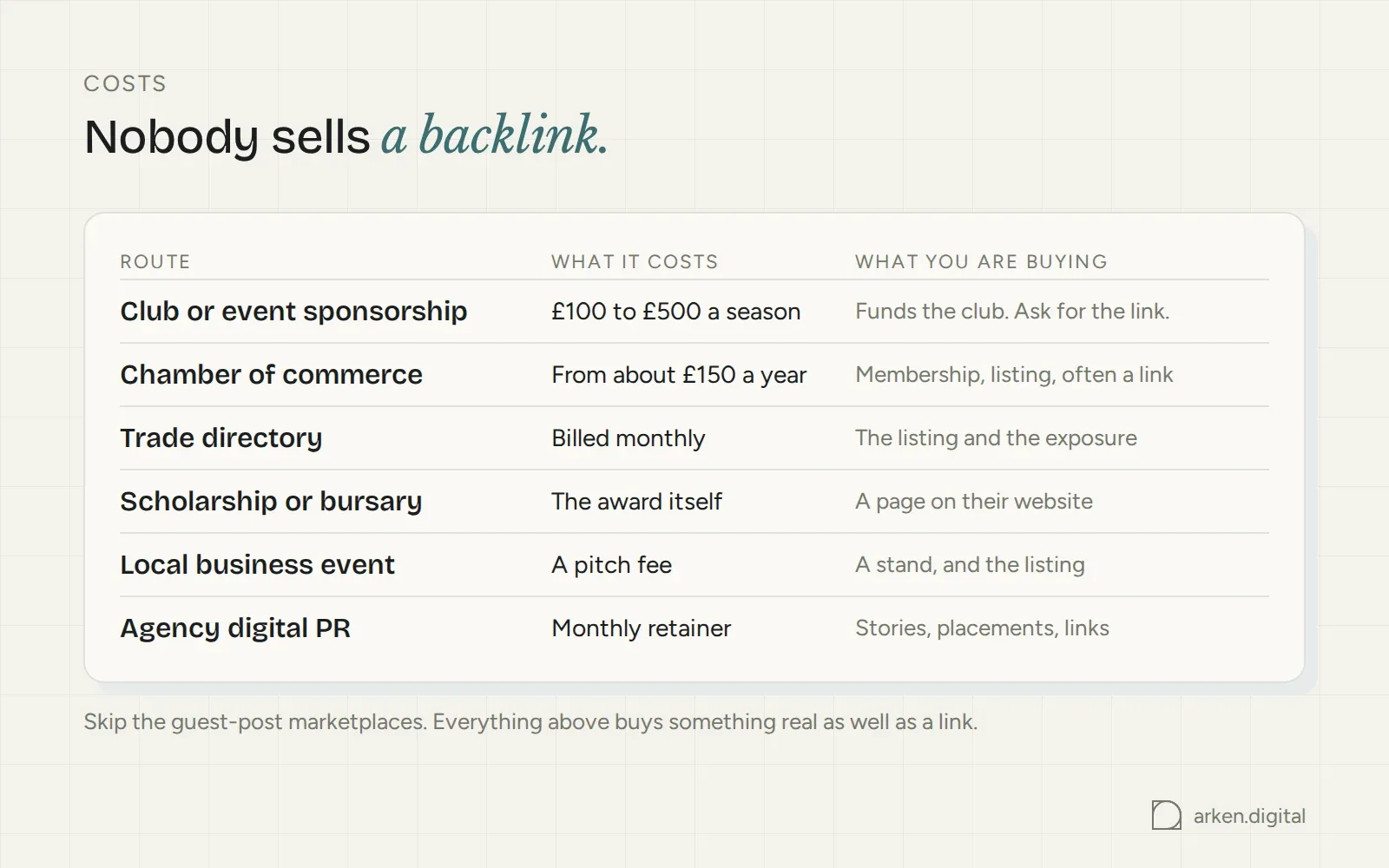
The free routes cost time, usually a few hours a month once the initial setup is done. Paid routes have real, visible costs. A club or event sponsorship is typically £100 to £500 a season. Chamber of commerce membership starts at around £150 a year for a sole trader. Trade directories such as Checkatrade are billed monthly. A scholarship or bursary costs the award itself, a stand at a local business event has a pitch fee, and agency digital PR is normally sold on a monthly retainer.
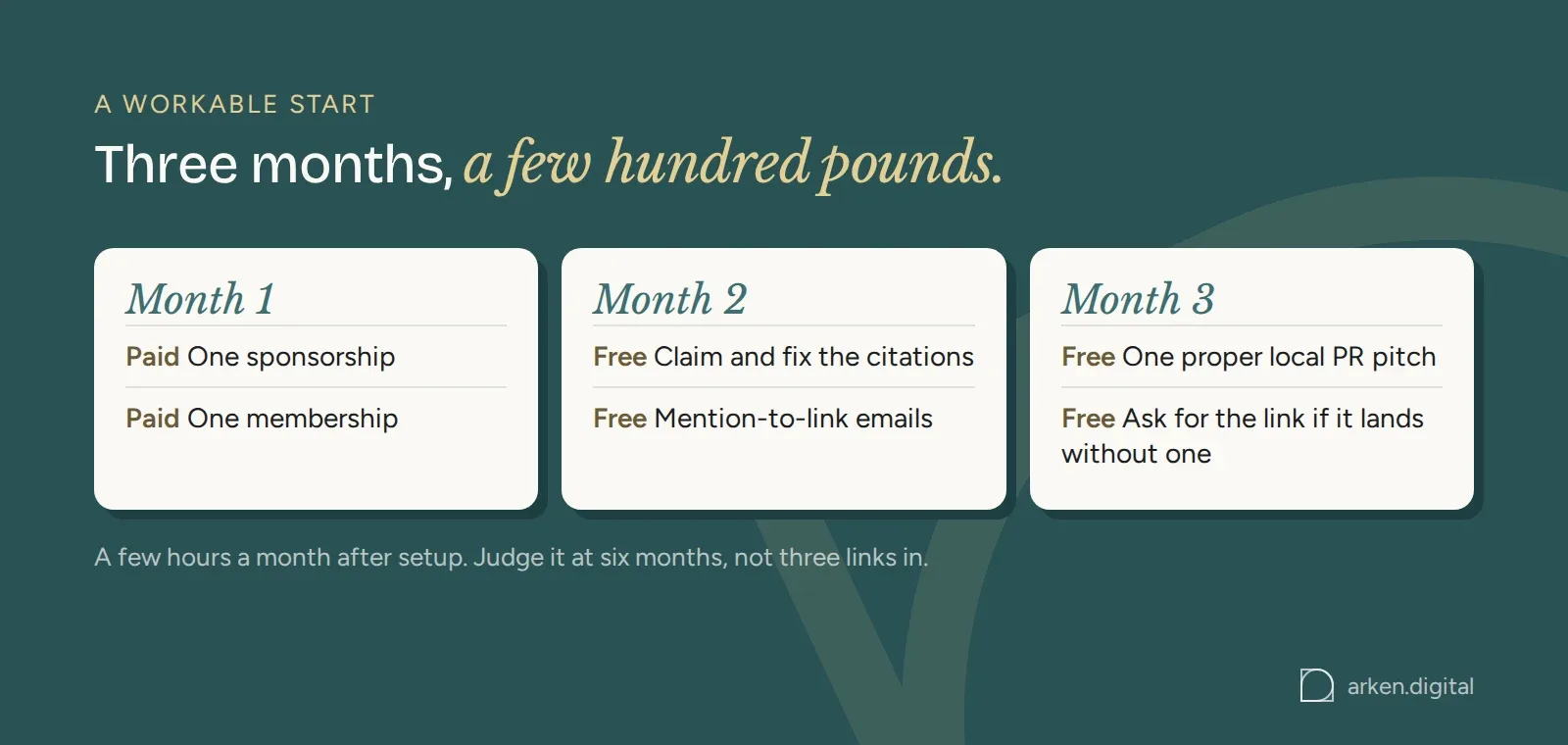
A workable three-month start could be one sponsorship and one membership in month one, free citations and mention-to-link emails in month two, then one proper local PR pitch in month three. That's a few hundred pounds and a few hours a month.
Skip the guest-post marketplaces. Google expects sponsorship links to be marked rel="sponsored" or nofollow. Do that. The ranking benefit has already been covered, and you're also buying something tangible: local exposure, referral traffic and association with an organisation people in your area already know.
This is the bigger point. SEO used to involve a lot more time trying to trick an algorithm. Now the better approach is to make sure the business is doing good marketing, because good marketing leaves signs. In this case, those signs are links.
Local citations
Citations sit alongside link building and constantly get confused with it. They're doing a different job.
Why local citations matter for SEO
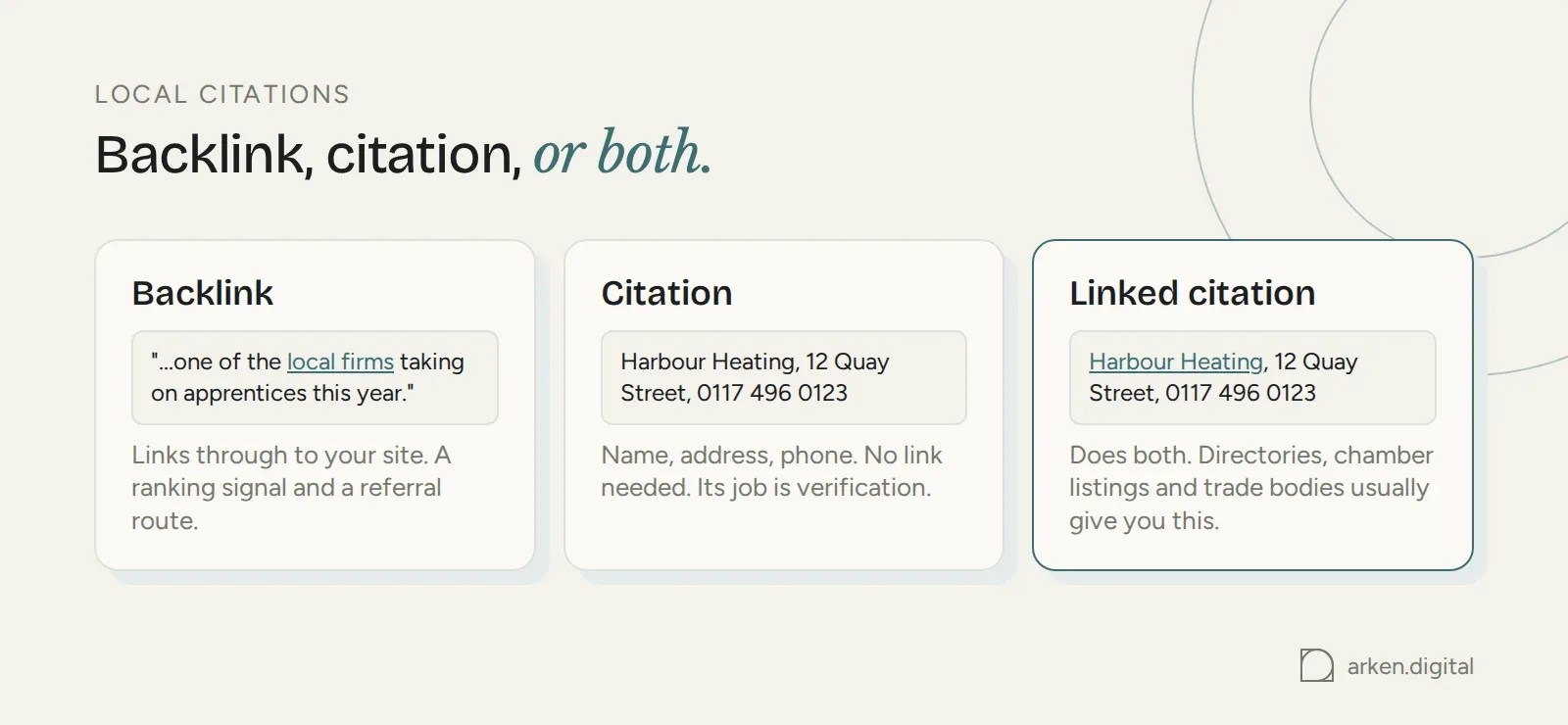
A citation is an online mention of your business name, address and phone number, usually shortened to NAP. Its main job is verification. It gives search engines another reference for who the business is, where it's based and how people contact it.
That's different from a backlink. A backlink links through to your website. A citation can exist without a link at all: an unstructured citation might simply be your business name and address mentioned in a local news article, while a linked citation can do both jobs.
Where we'd push back on conventional citation advice is the obsession with making every historical mention of your business identical. If Yelp has your correct phone number and Yell has an old one that customers are still finding, fix it. If a dead website with no traffic has an address you moved out of ten years ago, spending half a day trying to get it updated isn't a sensible use of your time. Accuracy matters where people can actually find you. Prioritise prominent directories, partnerships, local websites and anywhere else a potential customer might reasonably see the listing, and make sure the information there is right.
Most platforms let you edit a listing once you've claimed it. Where they don't, use the "suggest an edit" or "report incorrect information" option. If the listing is pulling information from another source, correct that source first. Don't turn citation consistency into archaeology.
Which directories to claim first
The core set is short: Google Business Profile, Apple Business Connect, Yelp and Yell are the obvious places to claim and verify first.
Then move into directories specific to your sector. Home services businesses have Checkatrade and Rated People. Hospitality businesses have TripAdvisor and OpenTable. Most regulated professions have a public register or "find a member" directory attached to their governing body, and those listings carry relevance as well as verification.
Chamber of Commerce membership usually gets you a listing too, often with a link, and it's one of the more obviously local citations available.
If you're managing more than a handful of locations, citation-management tools such as Whitespark can make sense. They'll build and maintain listings at scale and flag inconsistencies you wouldn't realistically find yourself. For one local business, don't overcomplicate it.
Technical considerations: quality, relevance and best practices
Tactics get you links. These details help you avoid wasting time on the wrong ones.
Finding high-quality local backlink sources
Judge a website by its audience, not its score. Local newspapers, chamber of commerce pages, community blogs, council supplier lists, school and club websites, and regional trade publications all have one thing going for them: they're connected to the place you're trying to rank in.
Before pitching, ask two questions. Does this site publish things genuinely specific to your town, county or industry? Do real people appear to use it? If the answer to both is no, we don't care what its Domain Rating is.
Anchor text, nofollow and technical details
If you're doing link building properly, you shouldn't need to spend much time managing anchor text. Natural links naturally produce variation. Some people will use your business name, others will write "their website", "this guide" or something connected to the page they're referencing, and some will use a service phrase. That's what a real link profile looks like.
Repeated exact-match anchor text becomes a problem when you're manufacturing links and controlling how they're placed. A genuine local business will naturally accumulate different types of links over time, so don't start engineering ratios. If you're doing good marketing and earning links because people have a real reason to mention you, the mix largely takes care of itself. It only becomes something to worry about when you're trying to game the system.
Common link building mistakes to avoid
Don't buy spam links. Google's spam policies state that buying or selling links that pass ranking credit violates its guidelines, including paid placements dressed up as guest posts.
But don't confuse paying for a legitimate business activity with buying an SEO link. A chamber membership buys membership. A sponsorship funds the club or event. A directory fee buys the listing and whatever commercial exposure comes with it. Buying a placement on a website you don't care about, for an audience you don't care about, purely because somebody promised you a followed DR70 backlink, is different.
Use the test again: would you still pay for this if Google didn't exist? If not, you already know what you're buying.
The other common mistake is volume. Hundreds of irrelevant, low-quality directory links aren't impressive. They're mostly a very efficient way to waste your own time.
Analysing competitor backlinks to find your own opportunities
Your competitors have already done some of the research for you, so use it. Run two or three competitor domains through Ahrefs and look at the websites linking to them.
Ignore anything you can't realistically replicate. What you're looking for are the obvious opportunities: a shared local directory, a "best businesses in the area" roundup, a chamber listing, a sponsorship page for a club that accepts multiple sponsors. If three competitors all have the same worthwhile local link and you don't, that's probably a gap you can close.
But competitor backlink analysis only gets you so far. If a competitor has 100 good links, you're not going to reproduce all 100. And even if you could, copying somebody else's entire link profile only gets you to where they've already been. Use competitor research to build the foundation, then create links they don't have through your own PR, partnerships, sponsorships, relationships and useful content.
Tracking what actually matters: rankings, traffic and customer action
Authority scores aren't the point. Track outcomes.
Watch your position in the Local Pack for the queries that actually bring in work. Check your Google Business Profile insights for calls, direction requests and website clicks. In GA4, look at referral traffic from websites linking to you. If a local news story or club sponsorship is sending real visitors, that's useful information.
Then close the loop offline. Ask new enquiries where they heard about you. When somebody says they found you through the local paper, their trade association or the rugby club you sponsor, you don't need a Domain Rating report to tell you whether the link was worthwhile.
On timing, claimed listings and corrected citations can get indexed within weeks, but don't expect the Local Pack to transform because you built three links last Tuesday. By three months, with a sponsorship or two, a press mention and the important citations sorted, you should be seeing referral traffic and movement on less competitive queries. Six months is a fair point to judge whether the work is paying for itself.
I have been doing SEO for twelve years, six of them running client campaigns inside other agencies, and the last six running Arken. I started the company because I was tired of the way small businesses were sold SEO: big retainers, fuzzy deliverables, quarterly reports that explained nothing. Arken is my attempt to do the opposite. Plain English, shown work, honest reporting, steady results. Most of what I publish here is the stuff I wish clients had been told before they hired their last agency: what to ask for, what to refuse, what a useful month looks like. If you have a question about what you just read, send me a message and I will answer it myself.
More from RichardWant Richard to look at your site?
Submit your URL and you will get a 15-minute video walkthrough back. Free, no pitch, no follow-up sequence.
Get your free website review