How reviews and reputation affect your local SEO rankings

On this page · 1 of 7 ⌄
- Key takeaways
- What are the core local SEO ranking factors?
- Do online reviews actually affect local rankings?
- How many reviews does your business need?
- Managing your reputation: responses and monitoring
- Protecting against review risks
- What to expect from local SEO in 2026
The three primary ranking factors for local SEO are relevance, distance and prominence. Those are Google's own words, set out in Google Business Profile Help, Improve your local ranking on Google.
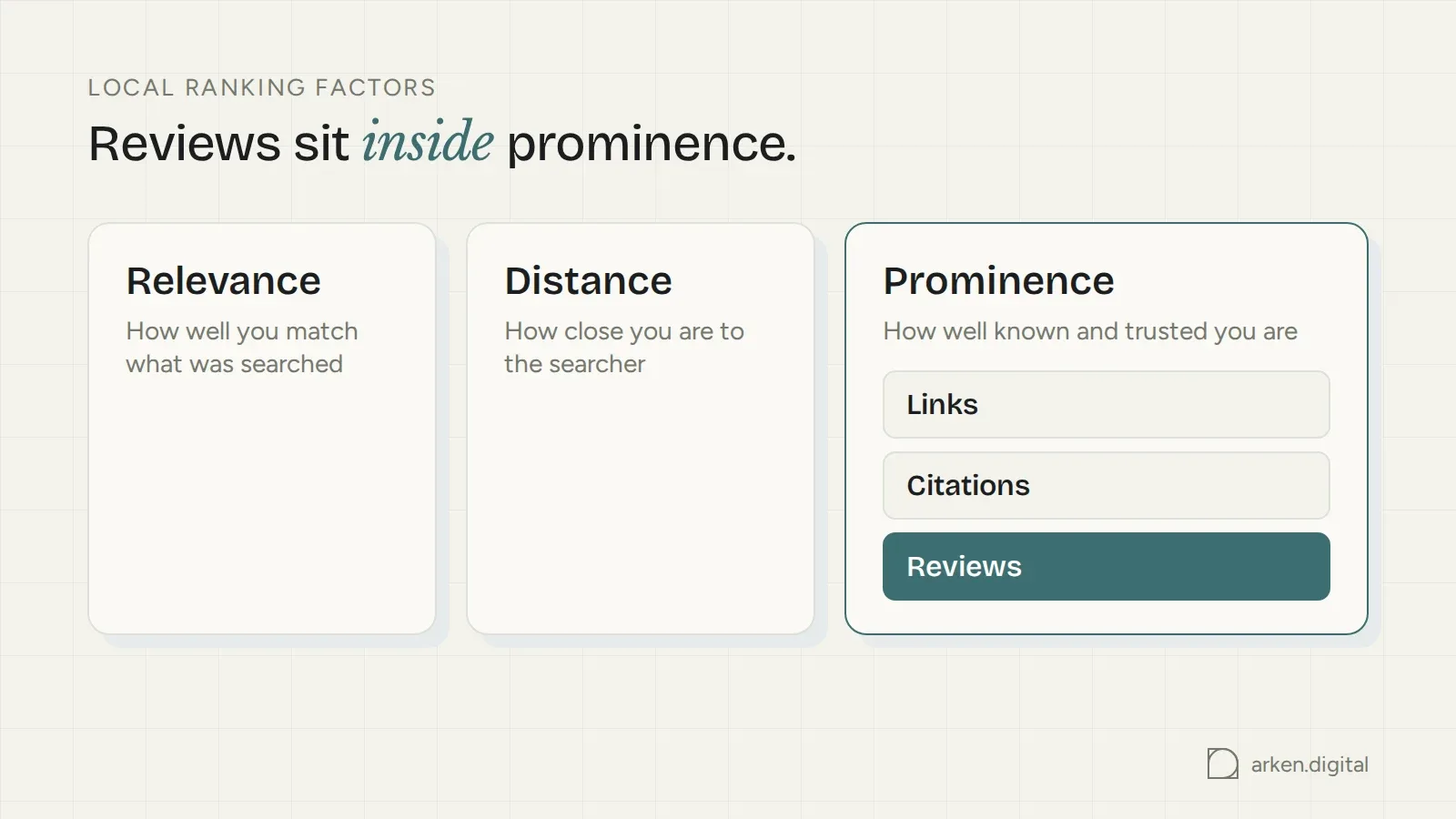
Relevance measures how well your business matches what someone searched for. Distance measures how close you are to the searcher. Prominence measures how well known and trusted your business is, and reviews are a big part of it. That's where reviews fit: inside prominence, not as some separate ranking lever.
Nothing in Google's ranking guidance has changed for 2026. It still lists relevance, distance and prominence, with no mention of AI summaries as a ranking input. What has changed is how reviews are presented. Google now generates AI summaries of review content inside Maps and Search, which gives the actual words your customers use another job to do.
Key takeaways
- Google names three local ranking factors: relevance, distance and prominence. Reviews sit inside prominence, alongside links and citations.
- Google's guidance states that review count and score are factored into local ranking.
- There's no published minimum review count for the Local Pack. Look at the three businesses already ranking for your main search term and use them as the benchmark.
- Fake and incentivised reviews breach Google's review policies. Under the Digital Markets, Competition and Consumers Act 2024 they're a banned unfair commercial practice, and the CMA has held direct enforcement powers since 6 April 2025, with fines of up to 10% of global turnover.
What are the core local SEO ranking factors?
Google has actually published the main signals behind local rankings, which saves a lot of guesswork. Where reviews sit inside that system is what tells you how much attention they're worth relative to everything else on your list.
The three pillars of local search
Google's local ranking guidance names three factors: relevance, distance and prominence.
Relevance is about matching. Does your Business Profile and website clearly say what you do, using the language people actually search for? A profile that only says "plumber" when customers are searching for "boiler repair" is giving Google less to work with than it should.
Distance is proximity between the searcher and your business location, or your service area if you work on the road. You can't do much about geography. What you can do is make sure Google knows exactly where you are and where you work.
Prominence is how well known your business is. Google builds that picture from information about you across the web, including links, articles, directory listings and reviews.
Reviews aren't a fourth factor. They're part of prominence. That's why they can influence where you rank as well as whether somebody chooses you once they find you.
And unlike distance, prominence is something you can keep building.
Start with your Google Business Profile
A complete, accurate Google Business Profile affects all three factors, so it's the obvious place to start.
Your categories and services shape relevance. Your address or service area settings shape distance. Your reviews, photos and posts contribute to the wider picture around the business.
Get the basics right: correct name, address and phone number, a primary category that matches your main service, accurate opening hours, and your own photographs.
Google's guidelines on representing your business also spell out what isn't allowed, including stuffing keywords into your business name. That can get the profile suspended, and a suspended profile ranks nowhere.
Do online reviews actually affect local rankings?
Yes. Google says they do.
Google's local ranking documentation states that review count and review score are factored into local search ranking. This isn't one of those SEO theories built from somebody running a test on twelve listings and posting a graph about it.
Reviews do more than influence ranking, too. They're sitting there when somebody compares you with the other businesses in the Local Pack, and the text gives Google material to use in its AI-generated review summaries.
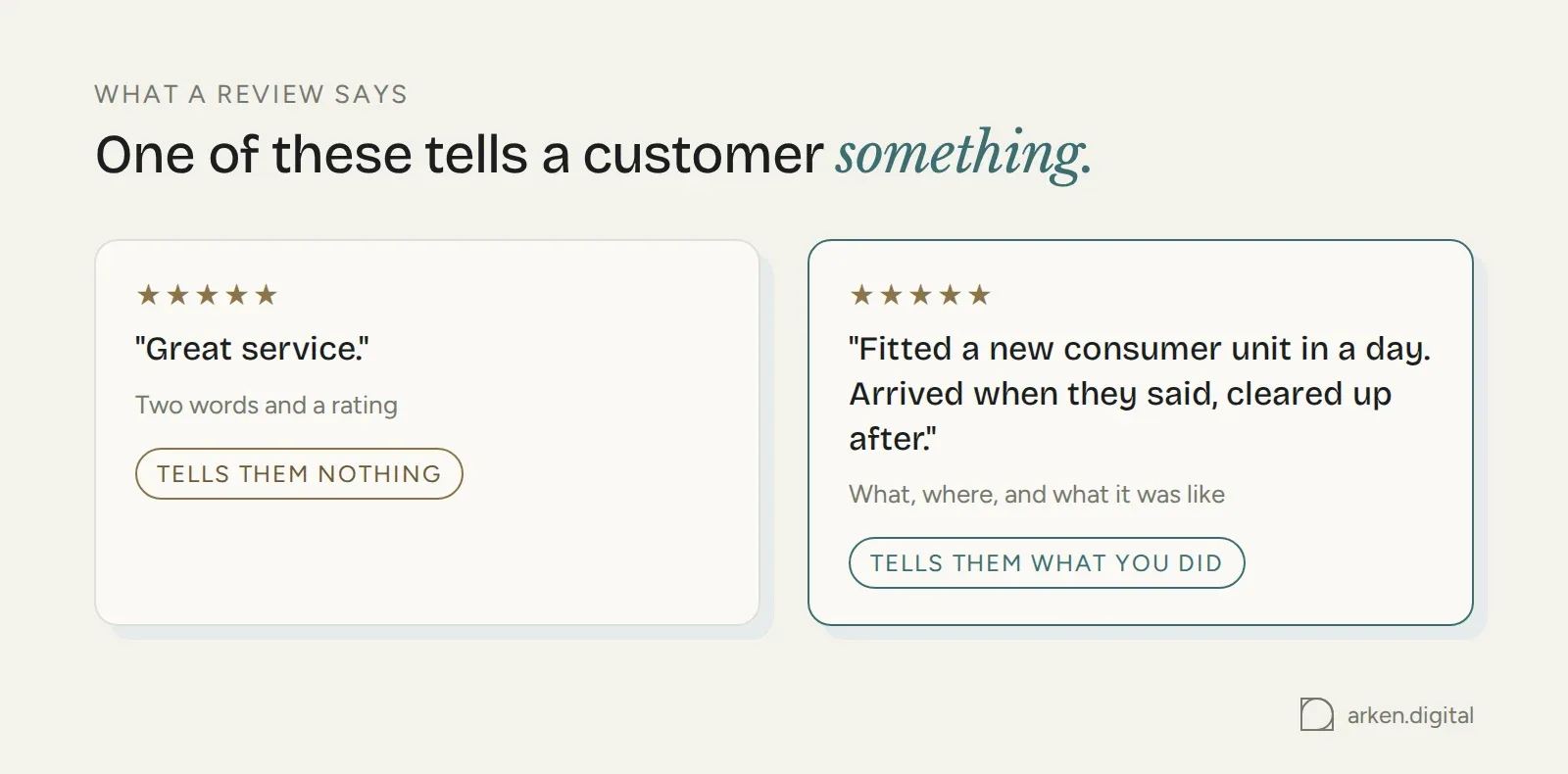
A review saying "fitted a new consumer unit in a day" tells a potential customer something useful. Five stars and "great service" tells them almost nothing.
You can't script what customers say, and you shouldn't. But you can give them a nudge towards the useful detail.
How can you generate more reviews?
Ask. Promptly and specifically, every time.
The biggest cause of a thin review profile usually isn't customers refusing to leave reviews. Nobody consistently asks them.
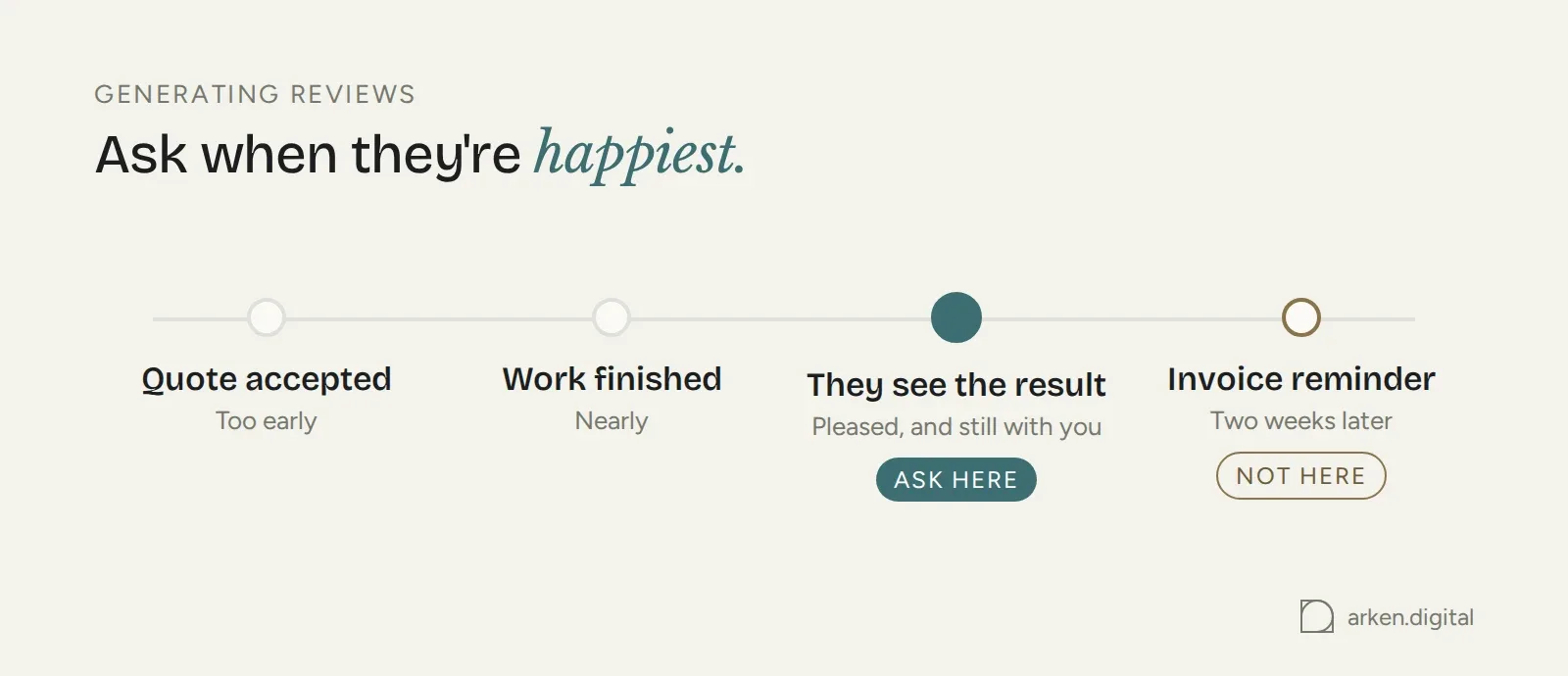
Build the request into the job. The best time is when the customer is happiest, which is normally when the work is finished and they can see the result, not two weeks later when an invoice reminds them they owe you money.
Make it one tap. Google gives every profile a short review link you can copy from your Business Profile dashboard. Put it in the follow-up text, your email signature and your invoice.
And prompt for specifics without writing the review for them. "It helps us if you mention what we did and where" is useful. Sending them a paragraph to paste into Google isn't.
There's another moment we tell clients to look out for. Most service businesses occasionally get a small request that sits just outside the agreed job: a quick favour, something that takes little time but matters to the customer. If you do it and they're clearly pleased, that's a very good moment to ask for the review.
Don't leave review collection to the occasional push. Build the ask into the job and keep it moving.
Never offer the customer anything in exchange. No discounts, prize draws or free extras. And don't buy reviews. They're usually easy to spot, they can get removed, and they can put the Business Profile itself at risk. It isn't worth it.
Reviews carry real weight for Map Pack visibility, and increasingly for how AI tools describe your business too. One thing we've found works well internally is rewarding staff for generating genuine customer reviews. The bonus is for the staff member who creates the good customer experience and remembers to ask. The customer still gets nothing for leaving it.
How many reviews does your business need?
There isn't one number. Anyone giving you a universal target is making one up.
Google hasn't published a minimum review count for the Local Pack. What you do have is a competitive benchmark sitting in the search results, and it takes about two minutes to find.
Minimum review count to compete
Search your main service plus your town. Look at the three businesses in the Local Pack. Note the review count and average rating for each. That's your starting point.
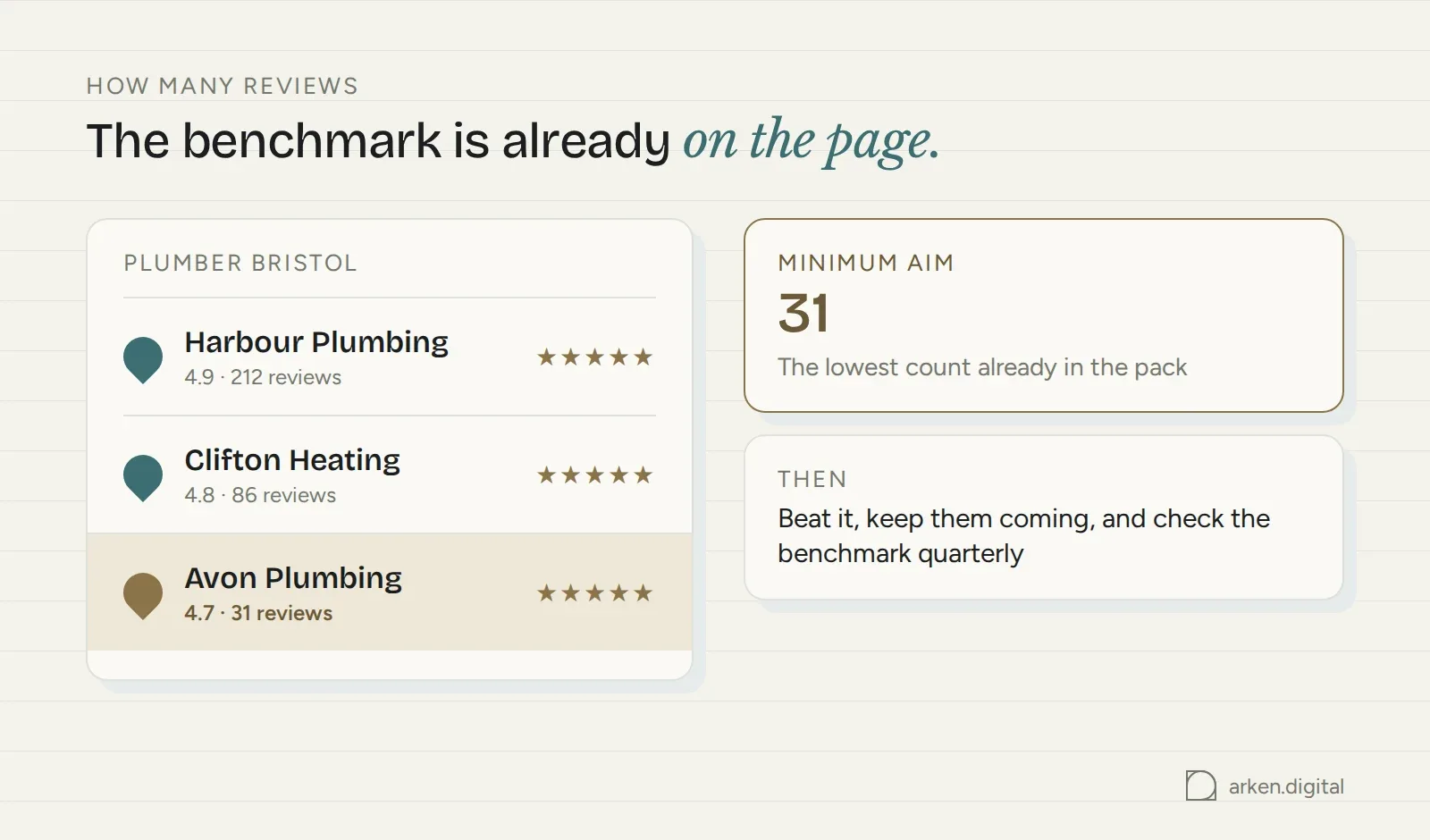
We normally look at the lowest review count already visible in the Map Pack and set that as the minimum aim. In an uncompetitive market, we've seen visibility increase significantly once a business gets beyond roughly 10 reviews. In a competitive market, 10 might get you nowhere. That's why the search result in front of you matters more than somebody else's benchmark.
To illustrate the difference, twenty genuine reviews could be enough to compete among four tradespeople in a rural area. Two hundred might barely get you into the conversation among sixty restaurants in a city centre. Those numbers are examples, not benchmarks. Your competition sets the target.
Quality matters more than quantity
Count isn't enough.
Forty reviews from 2019 tell me you had customers six years ago. Twelve detailed reviews from the last three months tell me you're doing the work now.
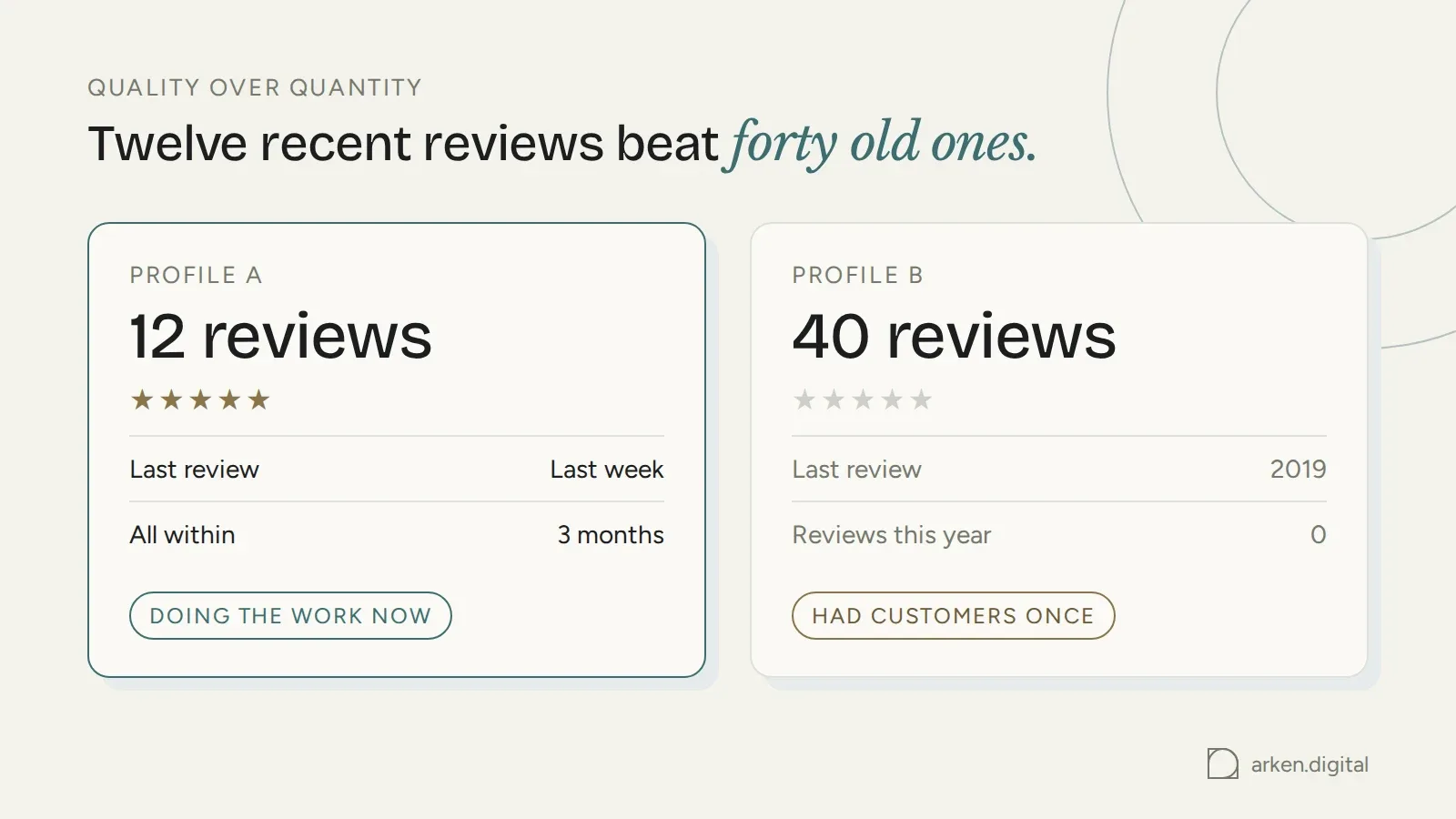
And detail changes the value of the review. "Great service" is a rating with two words attached. "Replaced our leaking shower tray in Leeds city centre, arrived when they said, cleared up after" tells somebody what you did, where you did it and what the experience was like.
Take Google out of it for a second. If you're choosing between two companies and one has a wall of generic five-star comments while the other has customers describing the exact problem you have and how the company solved it, which one are you calling? That's why specificity matters more than word count.
Photos can help too, particularly where the result is visible. If a customer is pleased with the finished work, ask whether they'd add a picture.
Consistency beats sporadic bursts
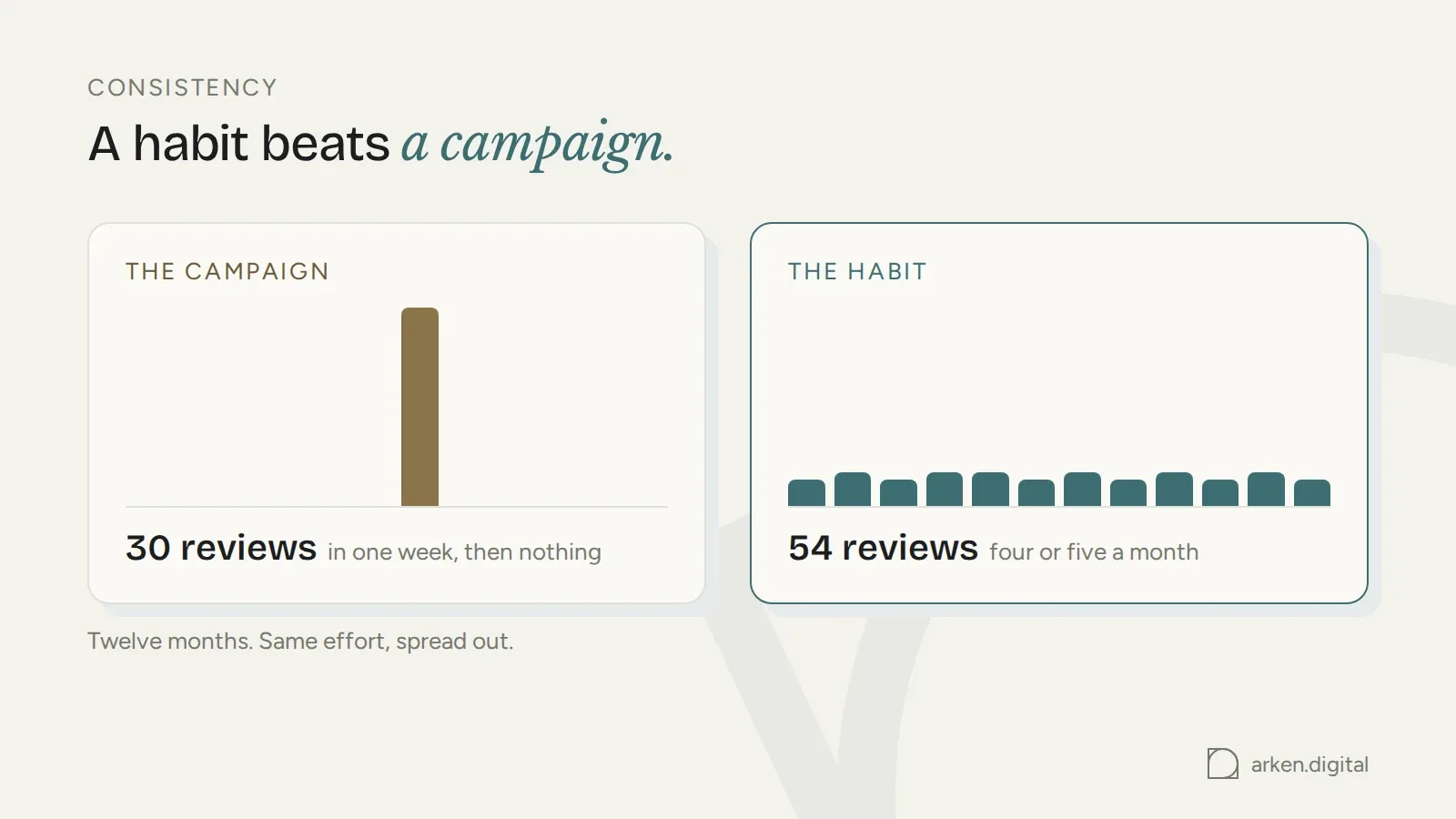
Don't collect reviews in campaigns. Build a habit.
Thirty reviews arriving in a week after two years of silence looks coordinated to anybody scrolling the profile. Then the burst gets older and you're back where you started.
Google's published guidance names review count and score, not recency. But customers can see the dates. If your newest review is fourteen months old, the profile looks inactive whether or not recency is being used directly as a ranking signal.
Set a realistic monthly rhythm and keep it going. If you complete forty jobs a month and consistently ask customers, four or five reviews a month is a perfectly workable target. That's sixty over a year without needing a desperate review drive every December.
Star ratings and recency: what else matters
Your average star rating is visible in the Local Pack before somebody has even clicked the profile. That alone makes it commercially important. Recency tells them whether that rating still describes the business they're about to contact.
Then there's the review text itself. Customers naturally use the names of services, locations and problems when they describe what happened. A driving instructor might end up with reviews mentioning "intensive course", "automatic lessons" and "test in Bristol" because that's what customers actually bought.
You can nudge that honestly. "If you have a minute to leave us a review, it helps if you say what we fitted." That's a prompt. Supplying the wording isn't.
Reviews still aren't the whole of local SEO. Whitespark's Local Search Ranking Factors survey groups review signals alongside Google Business Profile signals, links and other factors. You still need the rest of the work.
The target isn't some magic number. It's being a more convincing local result than the businesses Google is choosing between for that search. Check the benchmark quarterly and keep the reviews moving.
Managing your reputation: responses and monitoring
Getting the review is only half the job. Somebody needs to read it, reply to it and spot problems before they turn into a pattern. And none of that needs specialist software.
Why review responses matter to Google
Google recommends replying to reviews as part of managing your Business Profile and building customer trust.
It hasn't said that replies themselves are a ranking factor, so don't turn replying into another mythical Local Pack hack. Do it because customers read them.
A profile where the owner responds to good and bad reviews looks managed. Forty reviews with no response from the business looks like nobody's home. And when somebody complains, your reply is the only chance you get to put your side next to theirs.
Reply to every review, ideally within 48 hours.
How to respond strategically
Positive reviews don't need an essay. Thank them, mention the job, move on. Three sentences is plenty.
Don't paste the same "thank you for your kind words" response forty times. People can see it, and it makes the replies look automated even when they aren't.
Negative reviews need less emotion, not more. Acknowledge the actual problem. Say what you're doing about it. Give them a named person or phone number and take the conversation offline.
Don't fight the case in public, even if you're right. Anybody reading the exchange is judging how you handle an unhappy customer, not sitting as an appeals court for a one-star Google review.
And don't share customer details. In health, legal and financial services especially, even confirming what somebody bought can reveal more than you should.
If the review actually breaches Google's policies, that's different. Report it.
Setting up review monitoring systems
You don't need software. Put fifteen minutes in the diary once a week.
Turn on email notifications for new Google reviews in your Business Profile settings. Then check whichever other platforms your customers genuinely use: Facebook, Trustpilot for retail and services, Checkatrade or similar for trades, Doctify or comparable platforms in healthcare. Don't monitor ten platforms because somebody put them on a reputation-management checklist. Monitor the places where your customers actually leave reviews.
Log anything that looks like a policy breach as you go. If you need to report or escalate it later, you've already got the dates and details.
Protecting against review risks
Most of the serious review problems businesses run into are avoidable. Some are caused by unhappy customers. Plenty are self-inflicted.
Negative reviews and their real impact
One bad review isn't a crisis if you've built the profile properly.
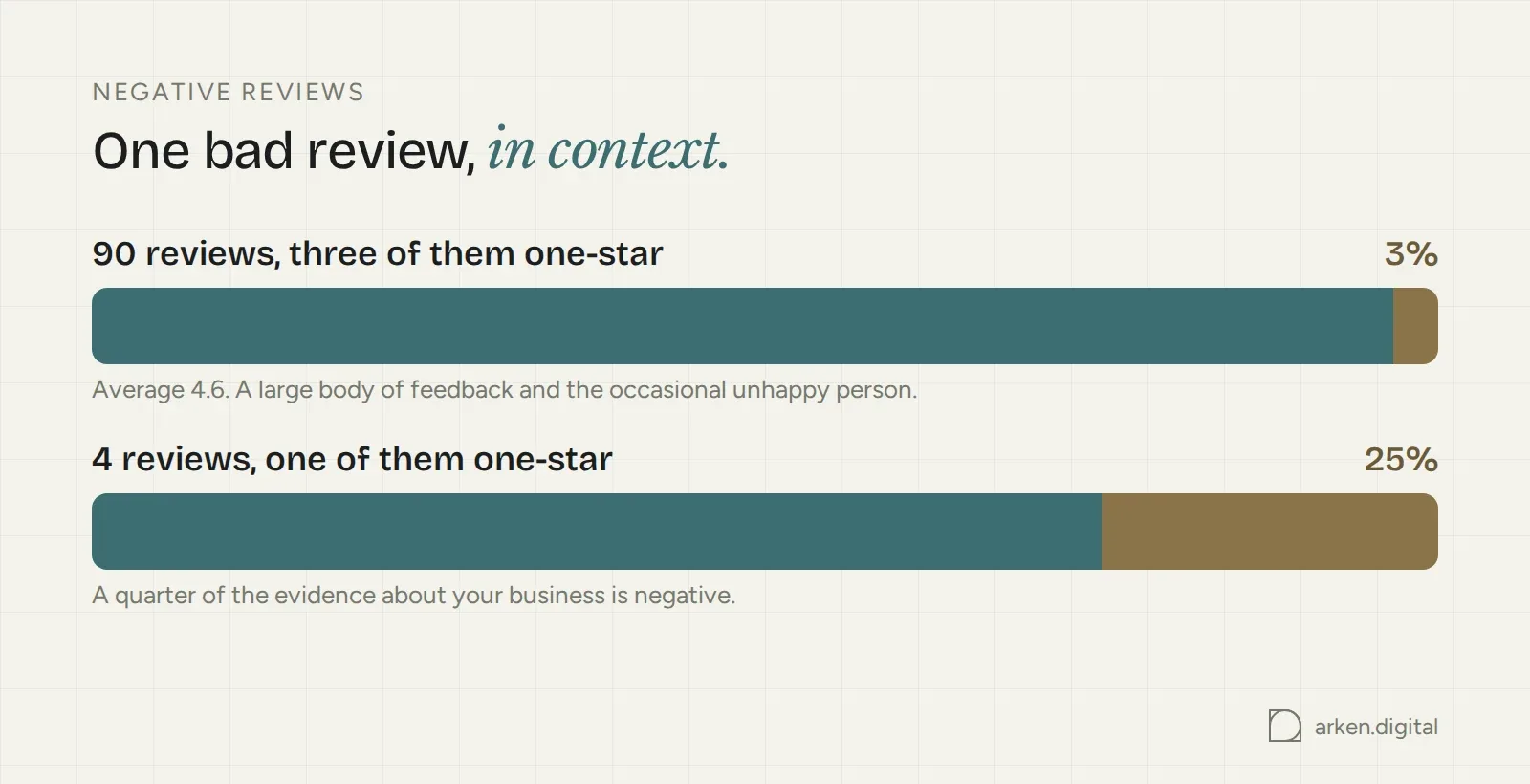
If you have ninety reviews averaging 4.6 and three are one-star, the average barely moves. More importantly, somebody reading the profile sees a business with a large body of customer feedback and the occasional unhappy person.
If you have four reviews and one is one-star, a quarter of the evidence about your business is negative.
That's the real protection a steady review programme gives you. It doesn't stop bad reviews. It stops one bad review defining the profile.
Why fake reviews backfire
Fake reviews are a terrible shortcut.
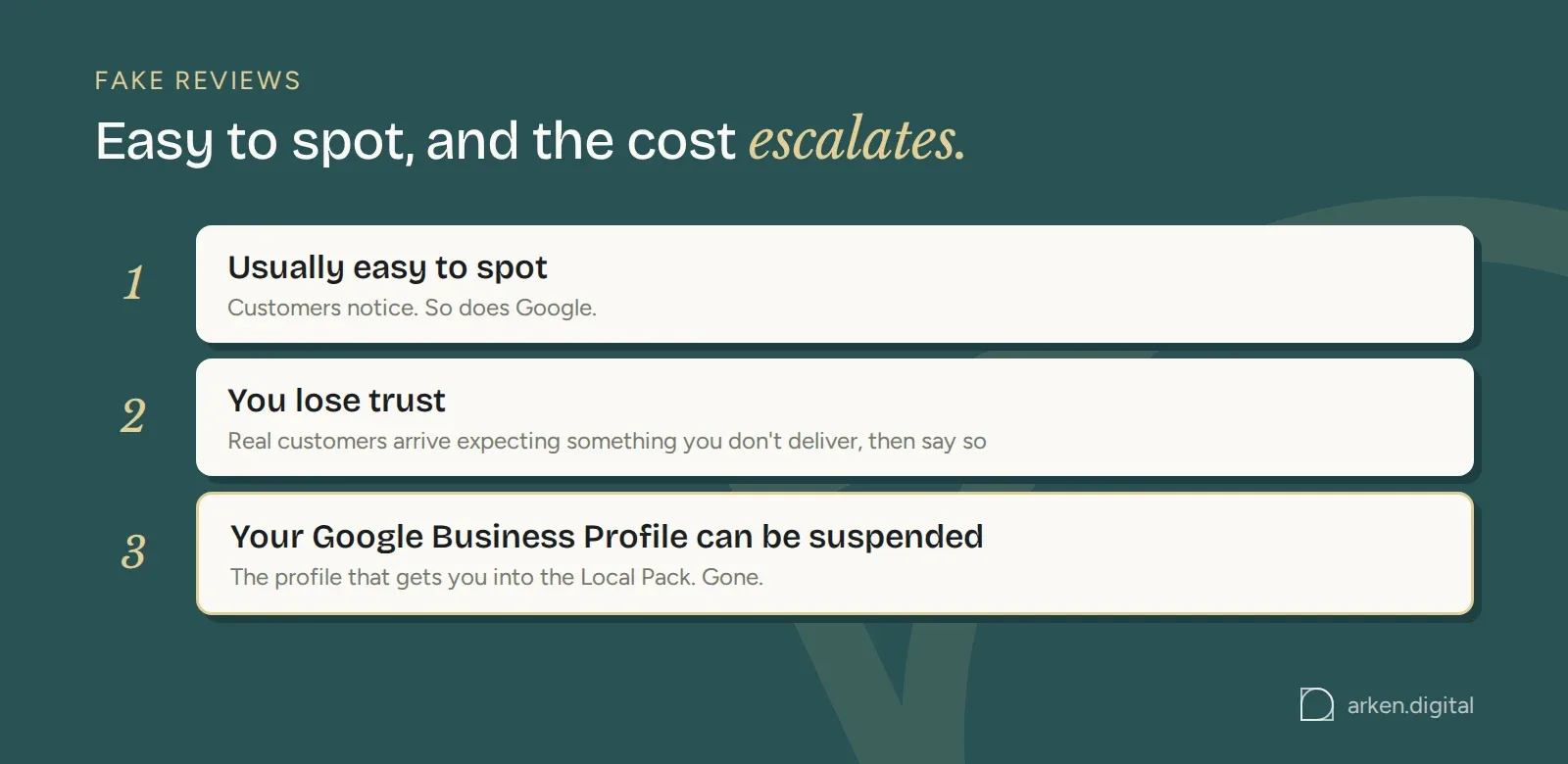
Google's review policies prohibit fake reviews, incentivised reviews and reviews from people without a genuine experience of the business. Reviews can be removed, and Google can take action against the Business Profile itself. Losing a few reviews hurts; losing the profile that gets you into the Local Pack is a different problem entirely.
There's also a legal dimension in the UK. Under the Digital Markets, Competition and Consumers Act 2024, commissioning or publishing fake reviews is a banned unfair commercial practice. The Competition and Markets Authority gained direct enforcement powers from 6 April 2025, with fines of up to 10% of global turnover. And that covers buying fake reviews as much as writing them yourself.
The commercial logic is poor anyway. Fake reviews create false expectations. Real customers then turn up expecting something you don't deliver and leave genuine reviews about it.
Review solicitation tactics that hurt SEO
Review gating is the obvious one. You survey customers first, send the happy ones to Google and divert unhappy customers to a private feedback form. Don't do it. Google's policies expect review requests to go to customers without filtering out the people you think might say something negative.
Mass solicitation is another bad idea. Blasting an old database of two thousand customers can create a sudden spike in reviews from people whose experience happened years ago. It looks exactly like what it is: a campaign rather than a normal stream of customer feedback.
Then there are incentives. Discounts, prize draws, free coffees or anything else offered to the customer in exchange for the review are out. Concealing that a review was incentivised is a banned practice under the same DMCC Act, with the same CMA enforcement behind it.
The clean version isn't complicated. Ask every customer, offer them nothing, and make the request when the job finishes.
Removing or responding to harmful reviews
If a review breaches Google's policies, use Google's official reporting process. That includes fake or off-topic content and reviews posted by somebody without a genuine experience of the business. A review being harsh or unfair doesn't automatically make it removable.
Competitor reviews and obvious non-customers are worth reporting and documenting.
Google is actually pretty good at dealing with obvious review spam. Timings vary, but if somebody is trying to extort you or is clearly posting fake negative reviews, report it and follow up. If the first report doesn't resolve it, there are further escalation routes.
While that's happening, reply calmly. Don't give a fake review a real argument underneath it.
What to expect from local SEO in 2026
The interface is changing faster than the underlying local ranking system. That's the bit worth paying attention to.
AI integration into map listings
Google generates AI summaries from review content inside Maps and Search. Instead of expecting somebody to read ten individual reviews, Google can pull recurring themes together and show them directly.
That changes how review content gets surfaced. It doesn't create a new fourth ranking factor. Google's local ranking guidance still comes back to relevance, distance and prominence.
What it does change is the value of useful review text. If customers consistently describe the work you've done, Google has something meaningful to summarise. If the profile is full of "great, thanks", it doesn't.
So don't invent a new AI review strategy. Keep asking real customers for real reviews and give them a gentle prompt to mention what you actually did.
What stays the same
Relevance, distance and prominence are still the foundation.
Keep the Business Profile accurate. Keep genuine reviews arriving. Get customers talking about the actual work rather than chasing generic five-star ratings. Reply when they leave one.
The interface will keep changing. Those fundamentals don't need to.
I have been doing SEO for twelve years, six of them running client campaigns inside other agencies, and the last six running Arken. I started the company because I was tired of the way small businesses were sold SEO: big retainers, fuzzy deliverables, quarterly reports that explained nothing. Arken is my attempt to do the opposite. Plain English, shown work, honest reporting, steady results. Most of what I publish here is the stuff I wish clients had been told before they hired their last agency: what to ask for, what to refuse, what a useful month looks like. If you have a question about what you just read, send me a message and I will answer it myself.
More from RichardWant Richard to look at your site?
Submit your URL and you will get a 15-minute video walkthrough back. Free, no pitch, no follow-up sequence.
Get your free website review