How roofing businesses can build a digital marketing strategy that actually generates leads

On this page · 1 of 8 ⌄
- Key takeaways
- Why digital marketing matters for roofers
- How to build a digital marketing strategy for your roofing business
- Local search: Google Business Profile and local SEO
- Building trust through reviews and customer retention
- Paid advertising channels for roofing leads
- Social media and content strategy
- Tools and systems for scaling your roofing business
Digital marketing works for roofers when three things pull in the same direction: local search visibility, paid ads that catch people with an urgent problem, and reviews that do the trust-building before anyone picks up the phone.
Beyond that, you've got social media, email marketing and media sponsorships. They can all have a place. But roofing isn't a business where most people spend six months following you on Instagram before deciding they fancy a new roof. Usually, something happens. There's a leak, a gale takes three tiles off, or the roof has finally reached the point where it needs replacing. Then they search.
So make sure you're visible when they need you. That's the whole strategy in one line. Everything else in this piece is detail on how.
The returns build over months rather than days, particularly with SEO. They stall when nobody knows where leads came from, or enquiries sit unanswered while the homeowner rings three other roofers.
As the business grows, systems matter as much as channels. A CRM built for trades, such as ProLine, or a broader platform such as HubSpot, lets you track leads from first call through to invoice. Call tracking tells you which campaign produced which call. And your marketing calendar should flex with demand, including storm season and the spring and autumn replacement peaks.
The size of the business matters. A solo roofer doesn't need the same setup as a company running multiple teams. But if you're spending serious money on digital marketing, you need to understand the return from each channel. And it's very hard to do that properly without a CRM.
Key takeaways
- Build around local SEO and paid search first.
- Track return by lead source through to won jobs.
- Complete your Google Business Profile and keep the business information accurate, including matching your phone number exactly to the one on your website.
- Budget around 5 to 10% of revenue for growth and 3 to 5% to hold position, then review it against actual returns.
Why digital marketing matters for roofers
Homeowners rarely plan roofing work. Someone notices a damp patch, or a gale takes three tiles off, and they search that afternoon.
Good roofing marketing makes sure you're there when they do.
What ROI should you expect?
Paid channels move fast once you're live. Local Services Ads put you in front of people already searching for a roofer near them. Verification has to clear first, but after that, calls in the first week are common.
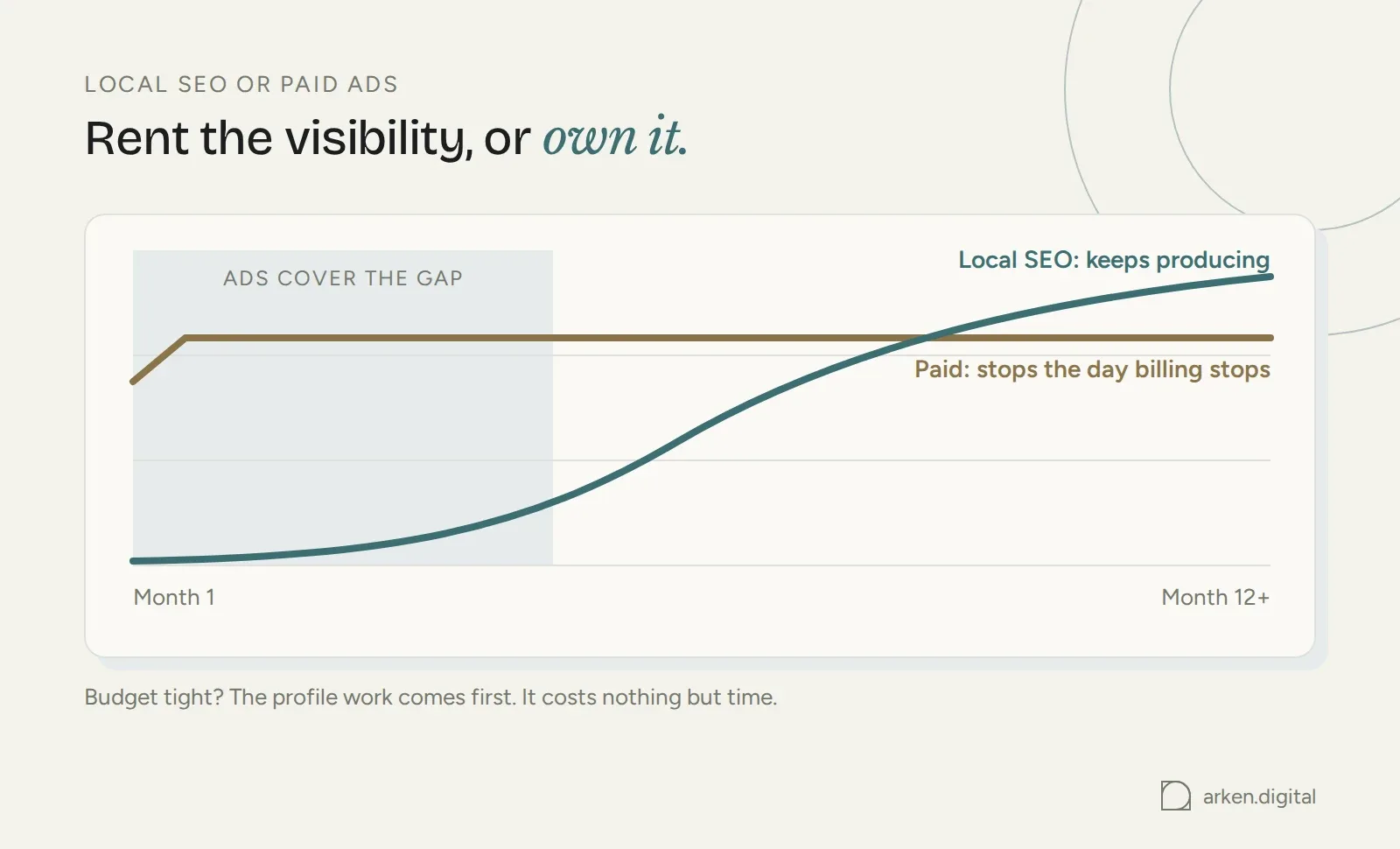
Local search visibility is slower to arrive, and it doesn't switch off. Map and organic visibility can keep producing enquiries after you stop spending, whereas Local Services Ads leads stop the day billing stops.
So judge them separately.
Work out cost per lead and then cost per won job for each source, using call tracking tied into your CRM. A single blended number hides the channel that's quietly losing you money and the one that's carrying everything.
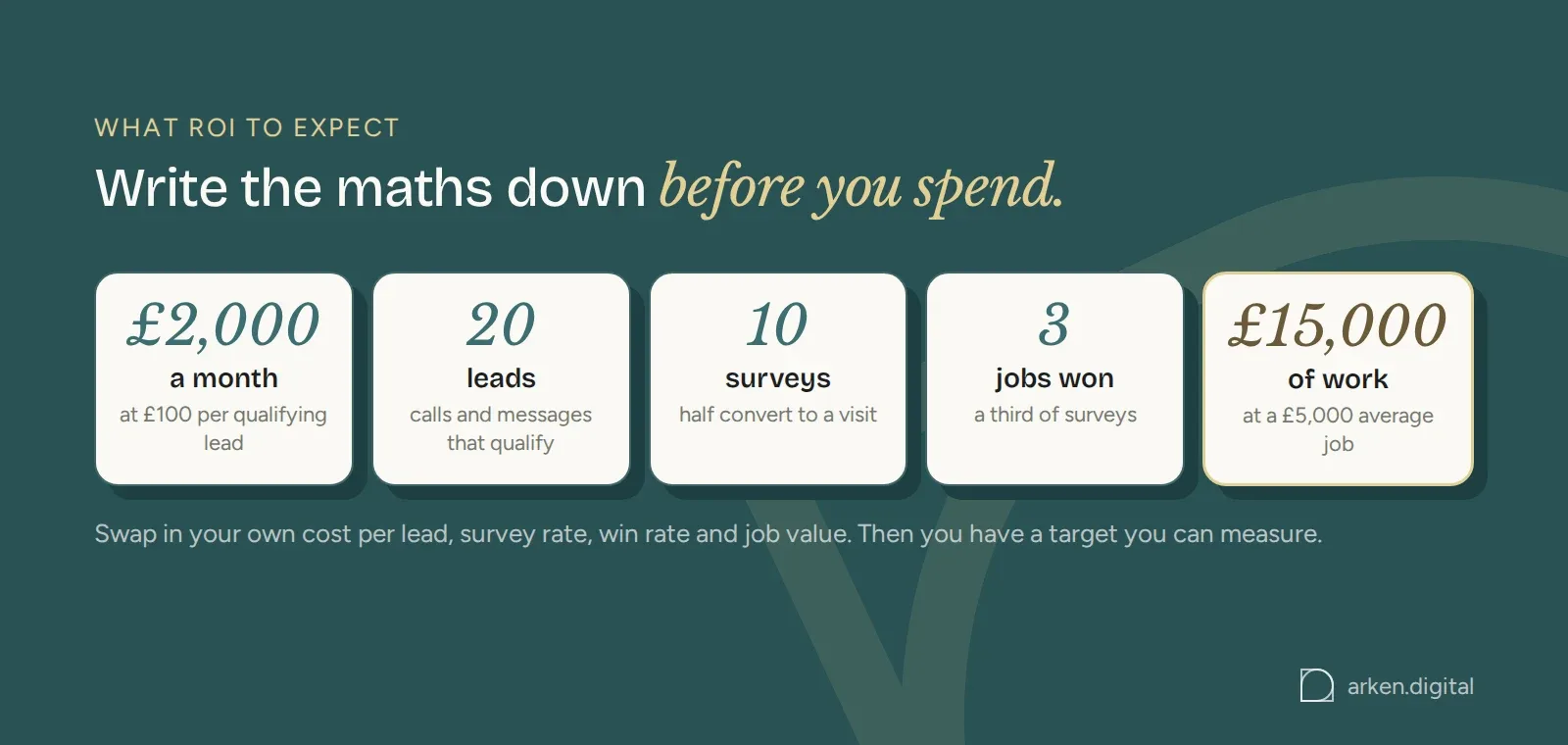
Write the maths down before you spend. Say £2,000 a month at £100 per qualifying lead gives you 20 leads. If half become surveys and a third of those are won, that's roughly three jobs. On a £5,000 average job value, you've generated around £15,000 of work against £2,000 of spend.
Swap in your own cost per lead, survey rate, win rate and average job value. Now you've got a target you can actually measure, not a number we've made up to sound precise.
Common reasons digital marketing underperforms
Three things commonly break it.
The first is measurement. If calls, form fills and Facebook messages all land in the same inbox with no source attached, you're guessing.
The second is follow-up. A lead called back within five minutes is far more likely to connect and qualify than one chased the next day. By then, the homeowner may already have rung three other roofers.
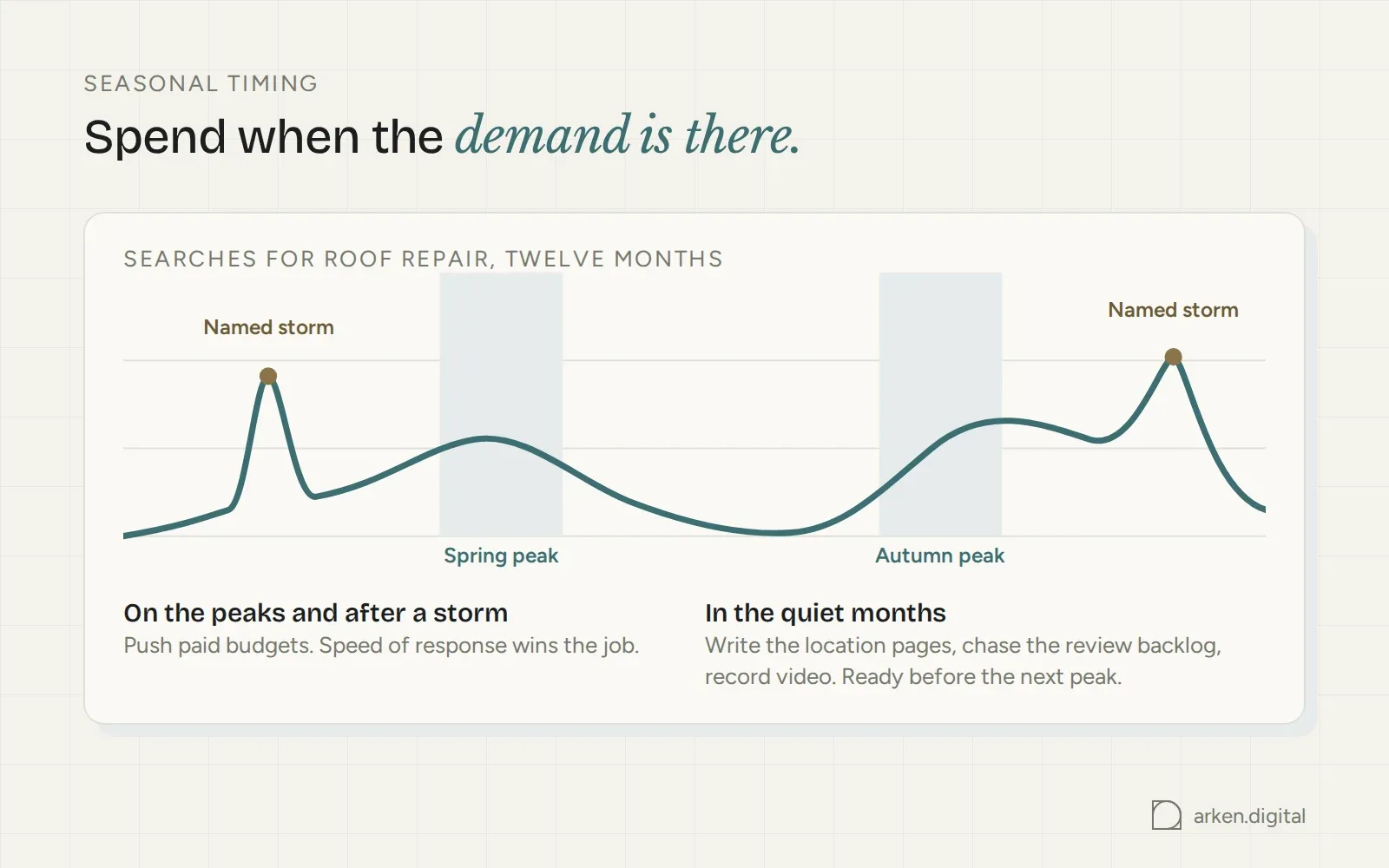
The third is timing. Roofing demand tracks the weather. Check Google Trends for "roof repair" in your region and you can see the spikes after named storms and the dip in settled months.
Review returns across a full season or a year. One quiet month tells you almost nothing.
How to build a digital marketing strategy for your roofing business
A strategy isn't a list of every marketing channel available. It's a decision about which three or four things you're going to do properly, how much you're going to spend and when you're going to review the results.
For roofers, that structure is fairly consistent whatever the size of the business.
Core pillars of roofing marketing
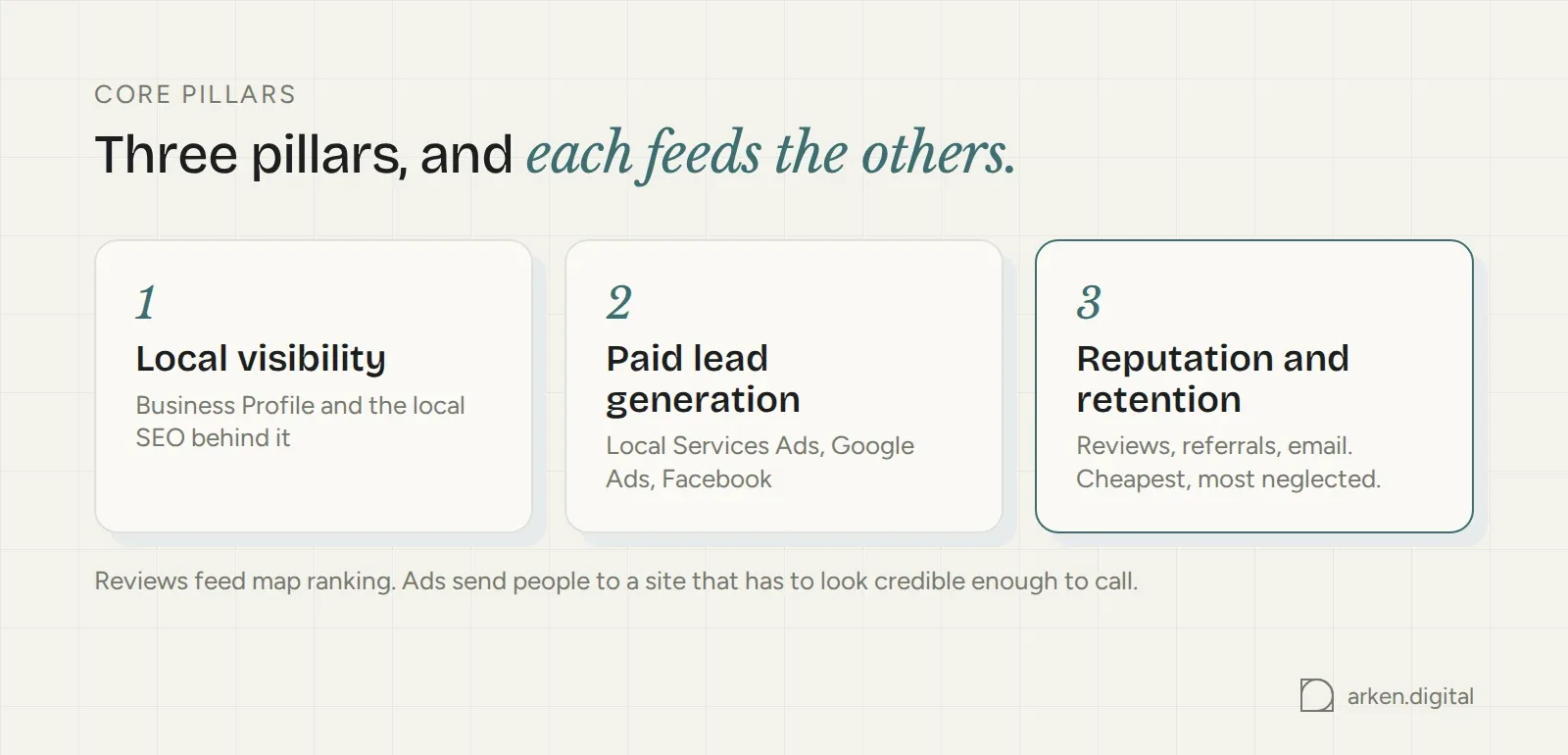
Pillar one is local visibility: your Google Business Profile and the local SEO work supporting it, so you appear when somebody in your patch searches for a roofer.
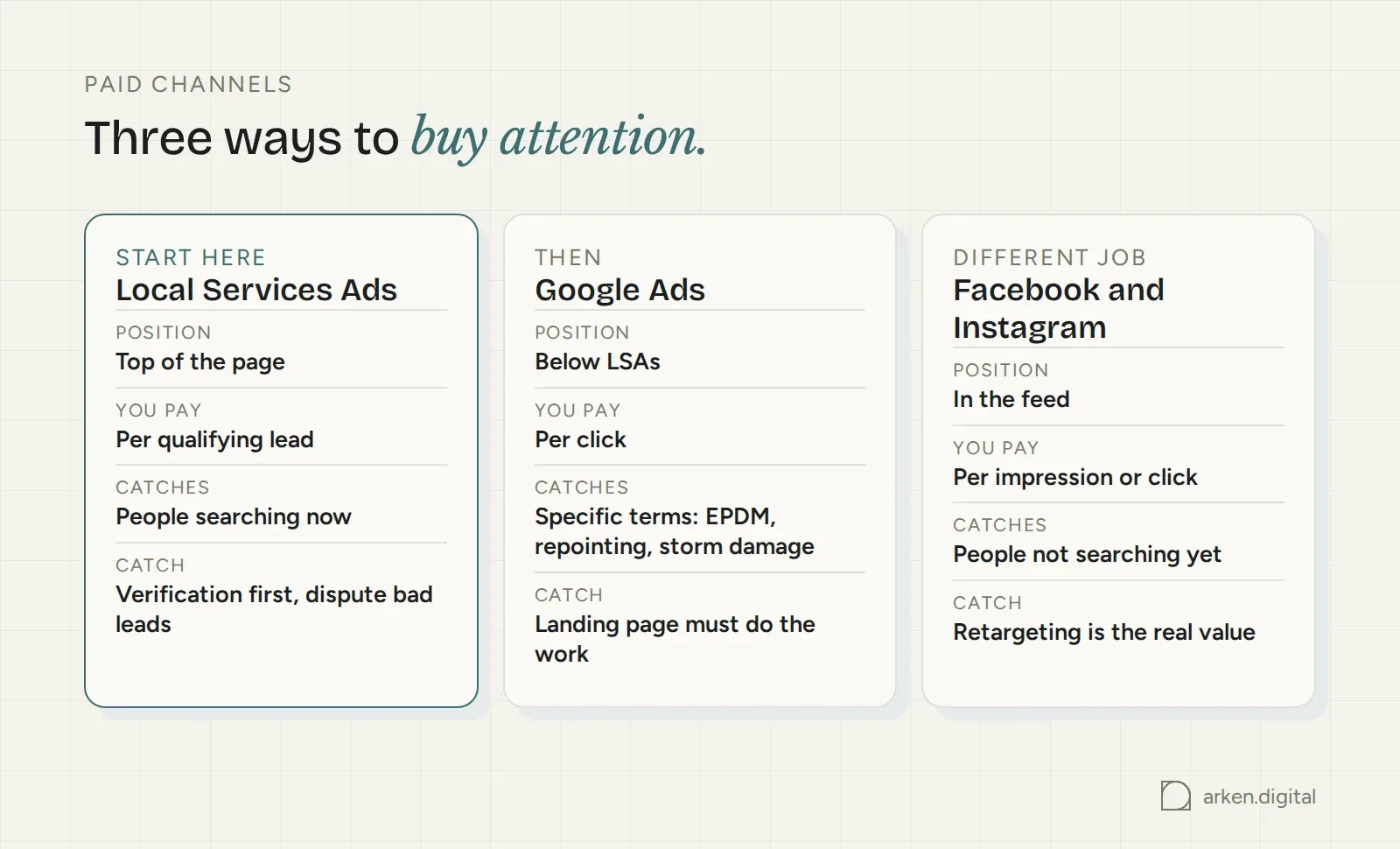
Pillar two is paid lead generation. Google Local Services Ads, standard Google Ads and Facebook each buy attention in a different way.
Pillar three is reputation and retention: reviews, referrals and email to past customers. It's the cheapest pillar and the one most often left to chance.
Each pillar feeds the others. Google lists reviews among the prominence signals behind local ranking, so reputation work supports map visibility. Paid ads send people to a site that then has to look credible enough for them to call.
Which channels deliver the best results
If you need customers today, prioritise Local Services Ads and a fully optimised Google Business Profile where Local Services Ads covers roofing in your country and you can pass verification.
Both put you in front of local people already looking for a roofer. That's a very different audience from somebody scrolling a feed.
Typically, the roofing companies with the highest growth rates combine SEO and paid ads as a core part of their digital marketing strategy.
That's where we'd start before adding anything else.
Facebook, Instagram and content marketing do a different job. They keep you visible before a roof problem becomes urgent, so your name is familiar when it does. That's worth having, but it won't fill next week's diary on its own.
How much should you budget?
The amount depends on the size of the company and how quickly you want to grow.
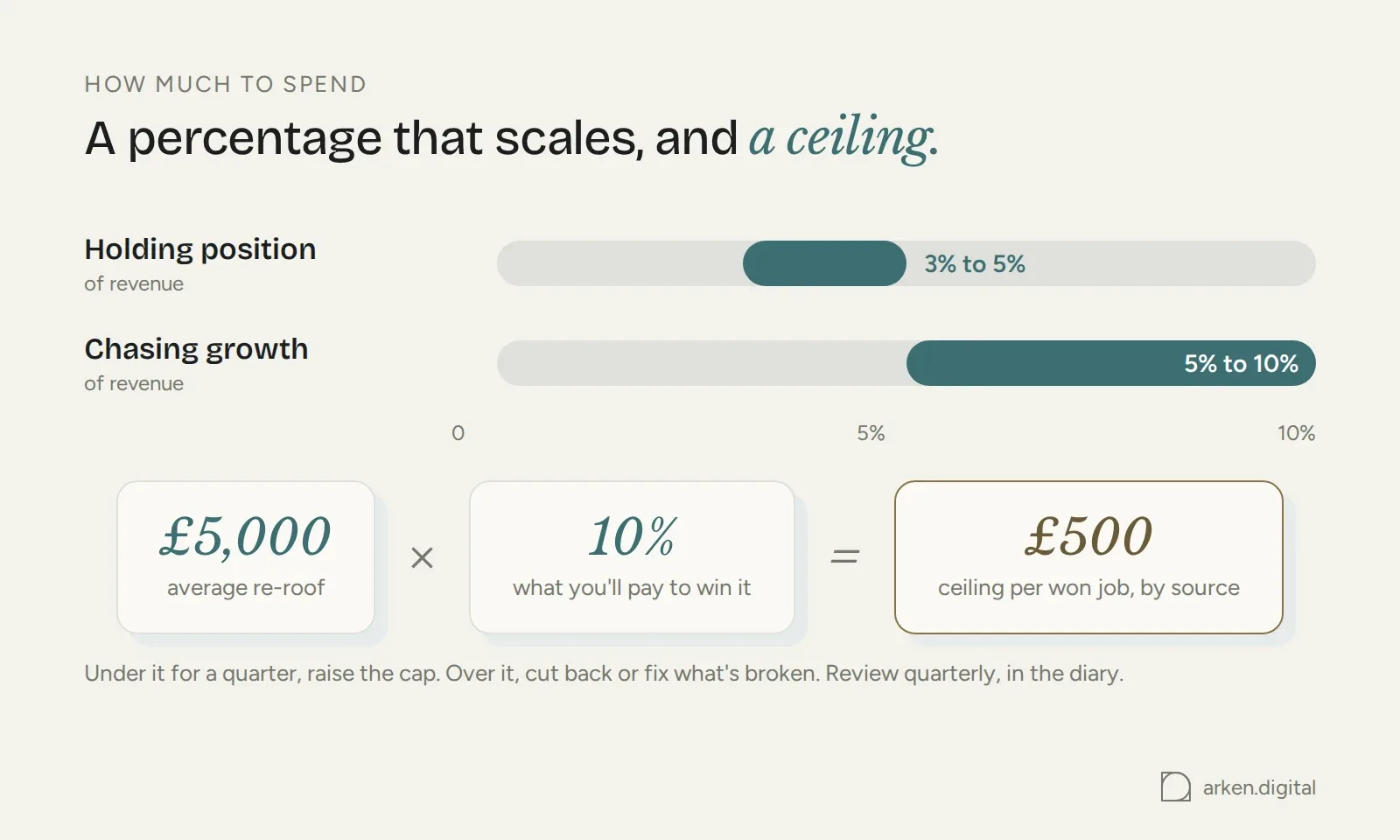
As a rough starting point, set marketing spend at around 5 to 10% of revenue while you're chasing growth and 3 to 5% to hold your position. A percentage of revenue scales with the business rather than becoming a fixed monthly number you picked once and never revisited.
A solo roofer with limited capacity has no reason to generate more enquiries than they can actually handle. A larger company trying to put another team on the road has a different problem.
Then review the budget quarterly against cost per lead and cost per won job, by source.
Set the ceiling first. If you're willing to pay 10% of average job value to acquire a job, that's £500 on a £5,000 re-roof. If Local Services Ads are consistently producing qualified work below that number, you've got room to increase the cap. If a channel sits above it for a quarter, cut it back or work out what's broken, including the landing page.
Put the quarterly review in the diary now. A budget nobody revisits stops being a decision and becomes a standing cost.
Local search: Google Business Profile and local SEO
Google Business Profile listings appear in the local map pack and Google Maps for local-intent searches. The listing costs nothing but your time, while Local Services Ads charge for leads.
That makes the profile one of the obvious places to start.
Optimising your Google Business Profile
Fill in every field. Primary and secondary categories, the towns you cover, opening hours and a phone number that matches the one on your website exactly. Mismatched numbers confuse both Google and the customer, and they're one of the first things worth checking if a listing isn't performing.
Set your service area properly rather than relying on a single pin, following Google's guidance on service areas.
Then keep it alive. Add photos of recent jobs every month: ridge work, flat roof replacements, chimney flashing. Don't leave the same four images up for three years. Respond to reviews within a few days of them landing.
Google's own explanation of local ranking comes down to relevance, distance and prominence. A complete, active profile gives Google better information about the business and supports the signals you can actually influence. Distance is fixed by wherever the searcher happens to be.
Local SEO fundamentals for roofers
If you're building a separate page for each town or area you serve, give every page a genuine reason to exist.
Don't build twenty copies of the same page and swap Bristol for Bath.
Work the place name naturally into the title, H1 and body copy, then add genuinely local detail: named jobs, relevant housing stock, photographs taken in that town, or other information specific to the work you do there. Otherwise you're drifting towards doorway pages, which Google's spam policies prohibit.
Keep your name, address and phone number accurate across the directories that actually matter. A dead phone number or old address on a listing customers use is a problem. A historical variation buried on a dead directory nobody visits isn't worth turning into an archaeological project.
Speed matters too, because these searches are often made on a phone. Check the actual location pages against Core Web Vitals and fix genuine mobile performance problems. Once the site loads properly and doesn't feel slow to use, stop chasing the score and work on something that will make more difference.
For keywords, use Google Keyword Planner or Ubersuggest to find the phrases homeowners actually type. They're often problem-led: "leaking flat roof", "slipped tiles", plus a place name.
Local SEO vs paid ads: which to prioritise
If you need leads this month, pay for them. Paid ads buy immediate visibility and you can turn them up or down quickly.
If you're building visibility you own rather than rent, local SEO is the better investment.
Most established roofers run both. Ads cover gaps and seasonal peaks. Organic and map visibility carry the baseline so you're not renting every enquiry forever.
If budget is tight, the profile work comes first. It costs nothing but time, and it gives you the basic local presence everything else builds around.
Building trust through reviews and customer retention
Few homeowners hire a roofer on the strength of a website alone. Reviews and past customers do a lot of the persuading, and both respond better to a simple routine than an occasional push when somebody remembers.
Generating and managing customer reviews
Ask at the final walkthrough, while the scaffolding is coming down and the customer is happiest with the finished job.
Make it one tap. Send a direct link by text or put a QR code on the invoice that goes straight to your Google review page.
Reply to everything, good or bad, quickly and without defensiveness. A calm reply to a critical review can reassure the next person reading it more than another generic five-star review.
Concentrate review volume on Google, because that's where people are already searching for and comparing local roofers. Treat Facebook and Yelp as secondary.
Don't pay customers or offer discounts in exchange for reviews. That breaks Google's review content policy and UK law on fake and incentivised reviews.
Email marketing to retain customers
Roofs are replaced once in a generation, so the money in your customer list isn't another new roof next month. It's maintenance, referrals and repeat visits to the same property.
Email keeps you in the frame between jobs. Gutter and moss clearance reminders, a seasonal check-up offer before winter, or a straightforward request to pass your name on are enough.
A quarterly or seasonal newsletter is usually plenty. Frequency matters far less than relevance. One useful email before storm season beats monthly filler nobody opens.
Paid advertising channels for roofing leads
Paid channels are how you buy demand you haven't earned organically yet. Each behaves differently, and mixing them up is how budgets get wasted.
Here's what each is actually for.
Google Local Services Ads
Local Services Ads sit right at the top of the results page, above standard search ads and organic listings, for eligible local service searches.
The important difference is billing. They run on a pay-per-lead model rather than pay-per-click, so you're charged for each qualifying lead, a call or message that meets Google's criteria, rather than every click.
Invalid or out-of-area leads need to be disputed if you want the charge reviewed or credited. That's worth knowing before your first invoice, not after.
Setup takes longer than a standard ad account. You go through verification before the ads run, including background and licence or insurance checks where required, and set a weekly budget cap for leads.
Get verification started early. It's the slow part.
Google Ads for roofing services
Standard Google Ads, the pay-per-click search ads, cover ground Local Services Ads can't.
That can mean broader or more specific searches: flat roof replacement, EPDM, chimney repointing, commercial roofing or emergency leak repair, with a town name attached.
You pay per click whether or not that person ever calls, so the landing page has to do real work. Send storm damage searches to a storm damage page, not the homepage.
Cost per click varies widely by market, and the expensive terms tend to be the high-value ones: roof replacement, new roof cost and emergency roof repair.
Plan a test budget that buys at least 100 clicks on the terms you care about, then build expectations from your own account data rather than somebody else's national average.
Add negative keywords early, starting with "jobs", "training" and "DIY". There's no reason to pay Google for somebody looking for a roofing apprenticeship.
Facebook and retargeting ads
Facebook and Instagram reach homeowners who aren't necessarily searching for a roofer when the advert appears.
You can target by location, age range and other permitted audience signals, plus lookalike audiences built from your own customer list where the platform allows it. Housing-related ads fall under Meta's special ad category rules in some markets, which restrict the targeting available. Worth checking before you build the campaign, not after it's rejected.
Before-and-after photos and short video walkthroughs of finished roofs do the work here. Stock photography gets scrolled past because it looks like every other advert in the feed.
Retargeting brings back people who've already visited your site or watched at least 15 seconds of a video without ringing. Homeowners gather and compare quotes before committing, so staying visible while they make that decision can be worth more than endlessly chasing new clicks.
Social media and content strategy
Social media and blogging rarely produce an emergency call today. What they do is build familiarity and proof, so when the leak appears, your name isn't completely new.
The trick is making it a by-product of work you're doing anyway.
Social media strategy for roofing contractors
Tie posting to jobs finished.
Two or three posts a week during a busy spell, fewer when you're quiet, is far better than nine posts in one afternoon and then silence until March.
Pick platforms by purpose. Facebook and Instagram suit visual, local content and community groups. Nextdoor can build hyper-local recognition, which matters when a neighbour asks who did the roof at number 12.
LinkedIn is worth the effort if you're chasing commercial or B2B work, where facilities managers and contractors are the buyers.
Pick two and keep them up to date. Four half-maintained accounts look worse than two that are current.
Visual content that converts: photos and video
Before-and-after photos are some of the most persuasive content roofing has. They show tangible proof in a single scroll.
Shoot the same angle before and after. Same time of day if you can manage it.
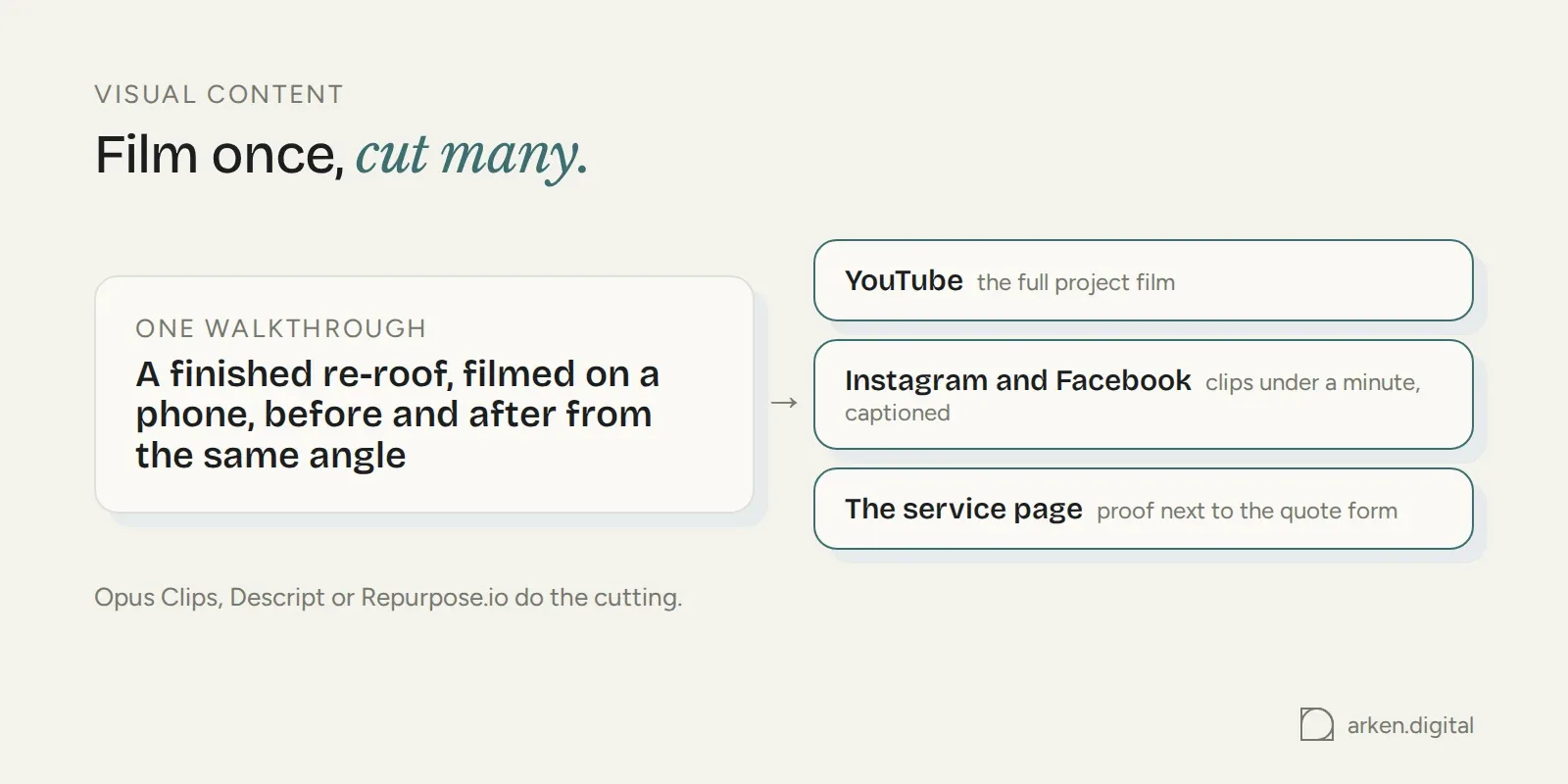
For video, film once and cut many. A single walkthrough of a completed job can become several short clips using Opus Clips, Descript or Repurpose.io, rather than filming separately for every platform.
Match the length to the platform. YouTube suits longer project films and explainers: how a flat roof build-up works, what a survey involves. Instagram and Facebook want the shorter clips, ideally under a minute, with captions because plenty of people watch on mute.
Content marketing and thought leadership
Blog posts that answer real homeowner questions support local SEO and give your sales conversations a shortcut.
Start with the questions you get asked on every quote.
How long does a tiled roof last? What does a leak actually cost to fix? Should you repair or replace? Do you need scaffolding for a small job?
Answer those properly. Ten genuinely useful pages carry more weight than fifty thin ones written to hit a keyword.
Add local specifics where they're true: the housing stock you work on, the weather that causes the calls, the conservation rules in a particular area.
Good content should make the website more useful and give your quote conversations something useful to point at. If it's doing neither, ask why you're publishing it.
Tools and systems for scaling your roofing business
Channels get you leads. Systems stop you losing them and tell you which channel was worth the money.
This is the part that decides whether more marketing spend actually turns into more jobs.
Choosing the right CRM for roofers
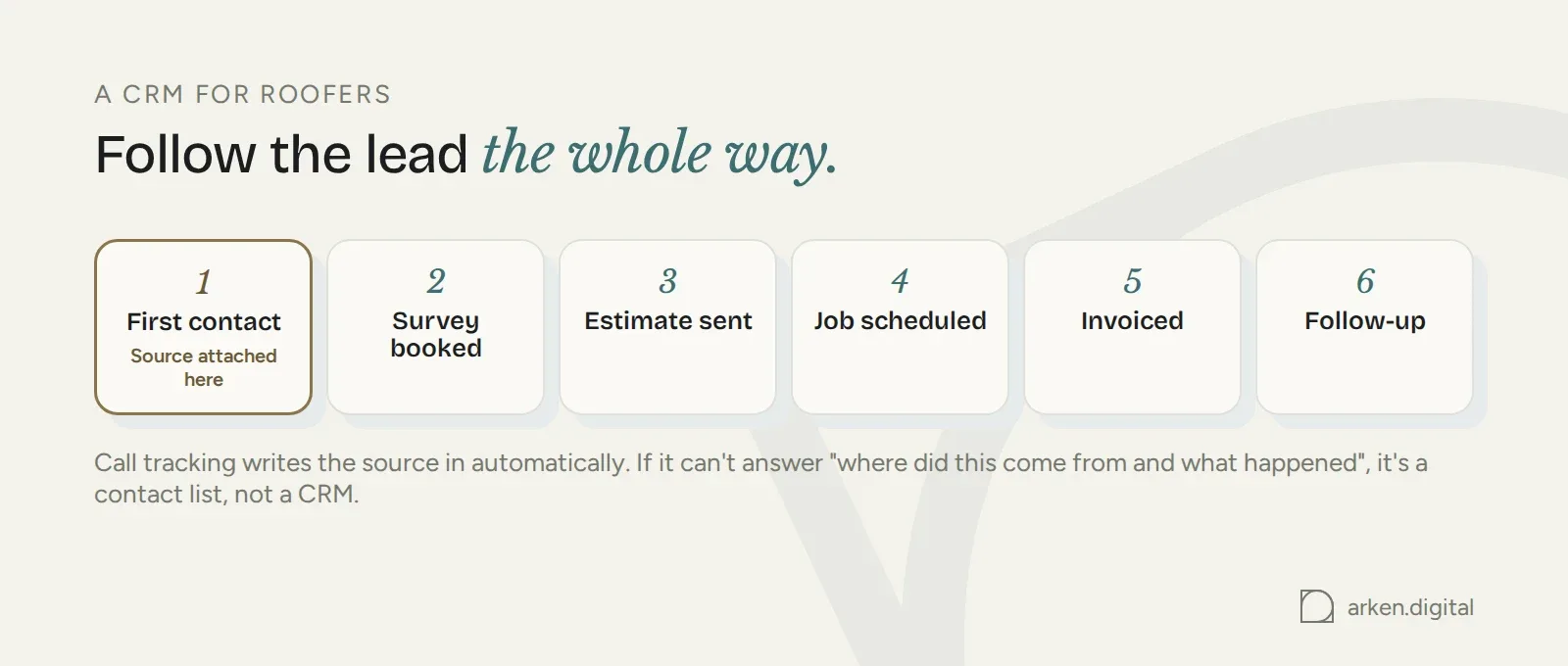
A roofing CRM should follow a lead the whole way: first contact, survey booked, estimate sent, job scheduled, invoice, follow-up. A contact list with phone numbers is not a CRM. We'd stop short of calling anything a CRM if it can't answer "where did this lead come from and what happened to it."
Wire call tracking into it, using CallRail or similar, so every lead's source is recorded automatically rather than typed in from memory.
Trade-specific platforms such as ProLine add job costing and scheduling alongside the pipeline. General marketing platforms such as HubSpot suit businesses that want deeper email, content and automation tools.
Zapier can connect the CRM, website forms and ad platforms so source data doesn't depend on somebody remembering to type it in.
The software isn't the strategy. If nobody updates it and you can't trust the numbers inside it, you've bought an expensive contact list.
Seasonal trends and marketing timing
The Google Trends pattern mentioned earlier spikes after storms, then again in spring and autumn as homeowners plan replacements before or after winter.
Spend with that rhythm. Push paid budgets harder around the peaks and after a named storm, when search volume jumps and speed of response matters.
Use the quieter months differently. That's when you write the location pages, chase the review backlog and record video, all of which can be ready before the next peak.
The point isn't to spend the same amount every month because that's what the spreadsheet says. Spend when the demand and your capacity justify it.
Twelve years in SEO, most of them for local service businesses. If you have a question about what you just read, just email. He answers.
More from RichardWant Richard to look at your site?
Submit your URL and you will get a 15-minute video walkthrough back. Free, no pitch, no follow-up sequence.
Get your free website review