How plumbers can market their business online

On this page · 1 of 8 ⌄
- Key takeaways
- Why digital marketing matters for plumbers
- Building your foundation: website and budget
- Getting found locally: SEO and Google Business Profile
- Attracting customers: paid advertising and lead generation
- Content and channel strategy
- Converting prospects into customers
- Avoiding common pitfalls
Digital marketing can mean many things. For plumbers, we'd make it much simpler: have a good website, have a social presence, and make sure you show up where customers are actually searching for you. Most of the time, that's Google, whether you're paying for the click or earning it organically.
You don't need to be everywhere. And you definitely don't need to launch six marketing channels at once because somebody gave you a digital marketing checklist.
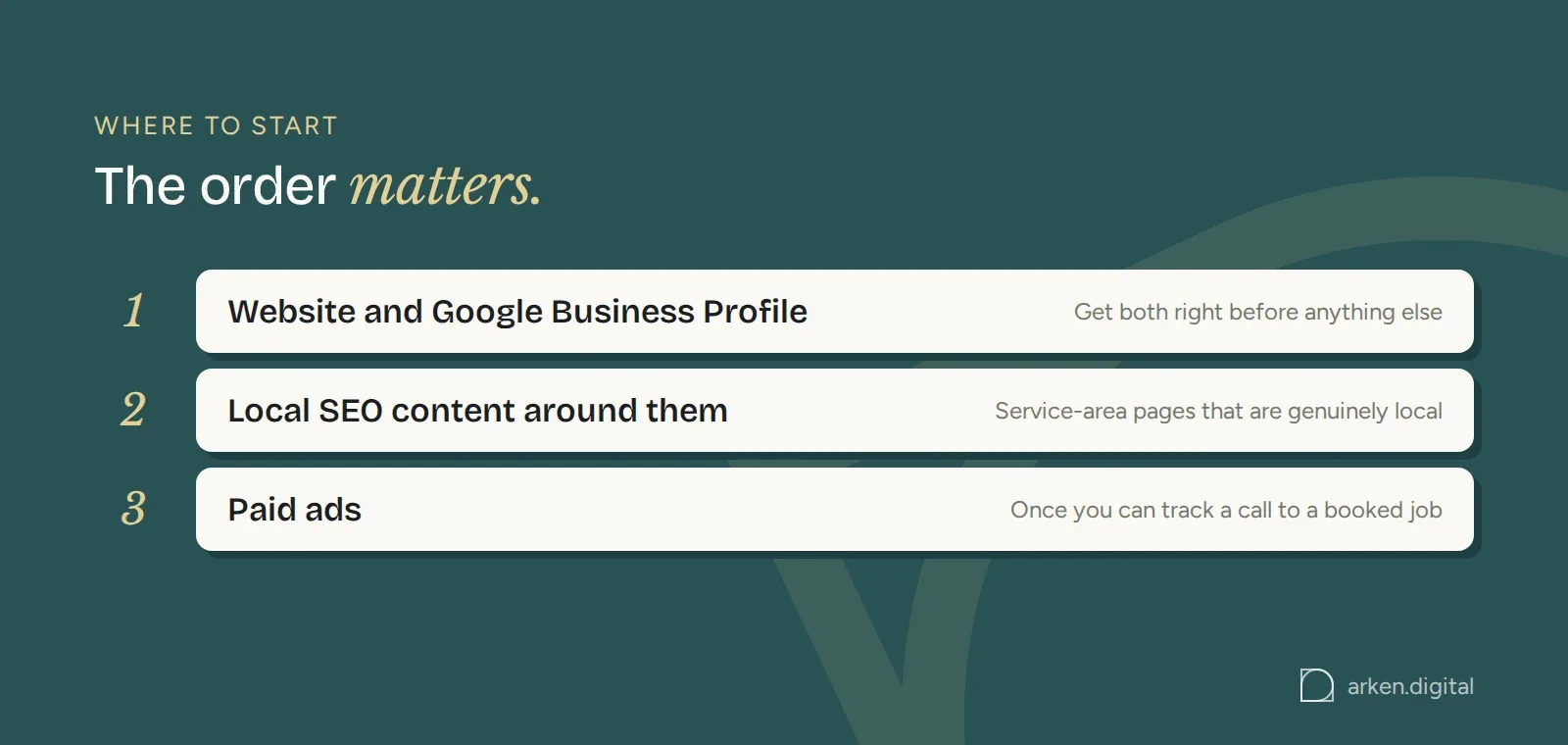
The order matters. Get the website and Google Business Profile right first. Build the local SEO content around them. Then use paid ads once you can track what a call is worth and whether it actually turns into a job.
It also helps to know what usually goes wrong: running paid ads without call tracking, leaving a Google Business Profile unclaimed or outdated, ignoring reviews (especially negative ones), and treating a website as a one-off purchase rather than something that changes with the business.
Make it ridiculously easy for people to contact you, track which enquiries become actual jobs, then put more money into the channels producing work.
Key takeaways
- Get the website and Google Business Profile right before adding more channels.
- Judge paid advertising on cost per booked job, not cost per click.
- Make it easy to call, message or book.
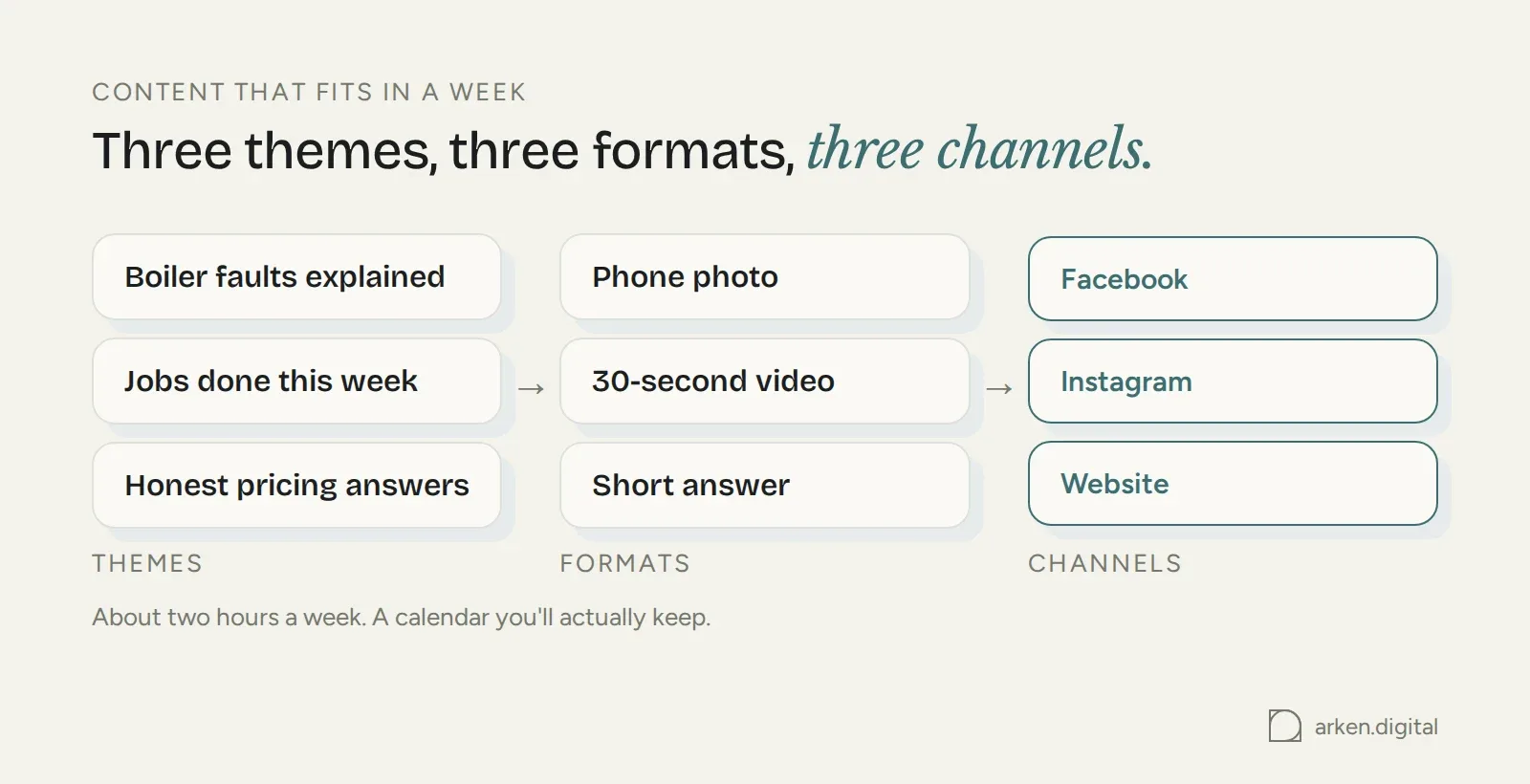
- Pick three content themes, produce each in three formats and publish to three channels each week.
Why digital marketing matters for plumbers
Word of mouth is still the best lead you'll get. The problem is that it doesn't scale, and it arrives on its own schedule rather than yours.
The search usually comes before the phone call. Someone with a leak opens Google on their phone, looks at the map results and rings whoever appears. If you're not there at that moment, the job goes to whoever is. That's the real advantage of digital marketing for plumbers: it puts the business in front of somebody at the exact point they're looking for what you do.
That doesn't mean vanity pages or leaflets don't work. They do. Local press can be particularly useful because good local coverage can also support your SEO. Traditional and digital marketing don't need to compete with each other.
Blend organic and paid. SEO and your Google Business Profile build over time and keep paying back, while Google Ads can cover the three to six months before that organic work produces steady enquiry volume.
For content, keep it manageable. Pick three themes, produce them in three formats and publish across three channels each week. That's enough to create a repeatable output in around two hours a week without building a content calendar you'll abandon after a fortnight.
But the biggest advantage of digital is measurement. You can see what generated the enquiry, whether that enquiry became a job and what the job was worth. That's what lets you stop guessing.
Building your foundation: website and budget
Ads and SEO both send people somewhere. Usually that's your website, so get the site right before you start paying to send more traffic to it. Then decide what you're prepared to spend.
Creating a website that converts
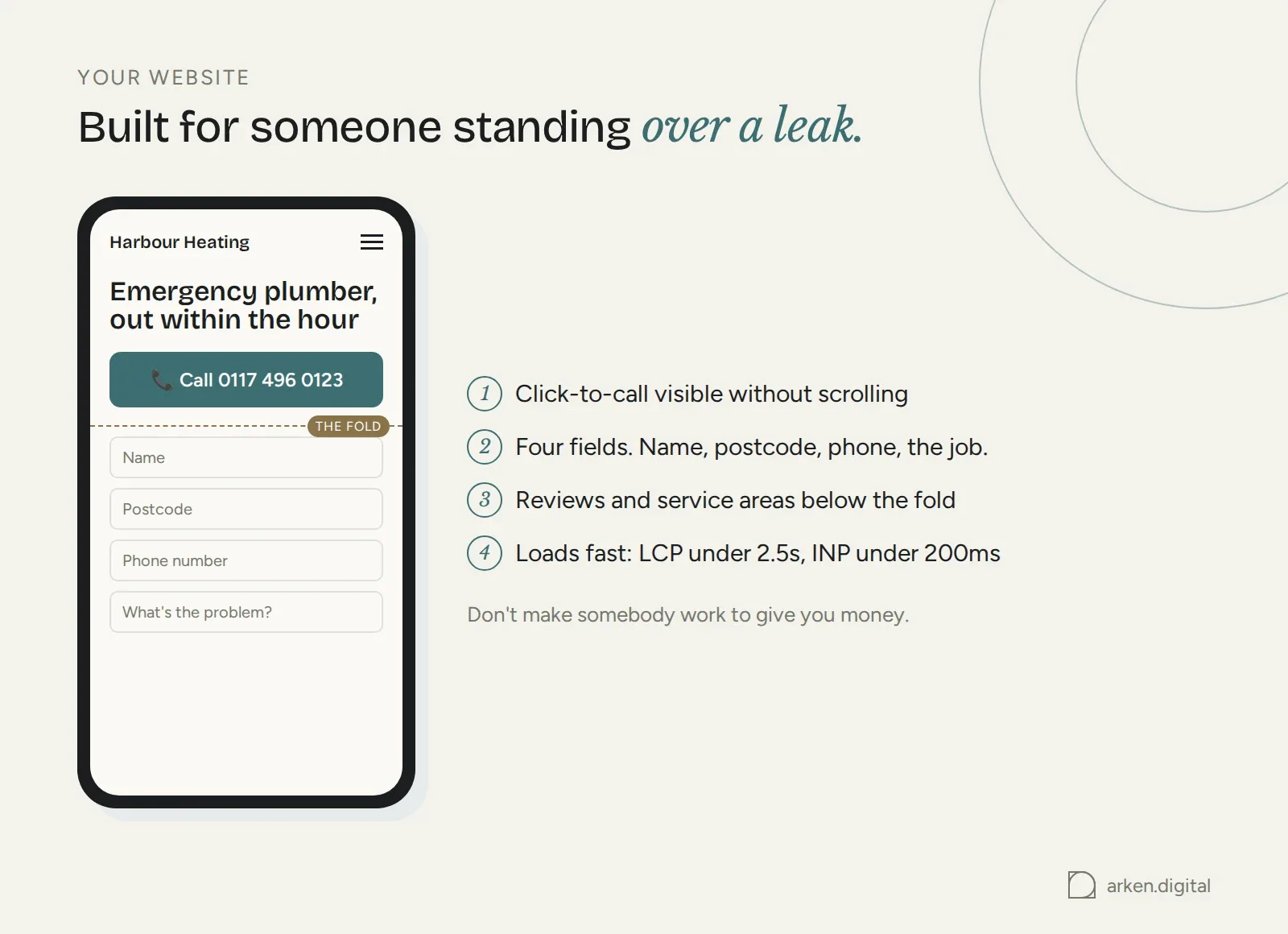
Build mobile-first. Assume the visitor is standing over a leaking stopcock with a phone in one hand. They shouldn't have to hunt through your website looking for a number. Put a click-to-call button somewhere they can see without scrolling.
You'll be amazed at the number of plumbing websites we review that bury the phone number. Don't make somebody work to give you money.
Beyond that, five things are worth prioritising: service-area pages, reviews on the homepage, clear pricing or callout information, a short booking form, and pages that load quickly. Google's Core Web Vitals set the technical thresholds: largest contentful paint under 2.5 seconds, interaction to next paint under 200 milliseconds, and cumulative layout shift under 0.1.
A template site with no service-area content will struggle to rank locally regardless of how good it looks. Design helps somebody convert once they're there; content gives Google something to rank in the first place. We'll get into the local content properly in the next section.
Keep the form short. Name, postcode, phone number and a job description is enough to ring somebody back. There's always a balance. You want enough information to understand the enquiry without turning the form into homework. Make contacting you easy first. You can ask the rest when you speak to them.
Setting your marketing budget
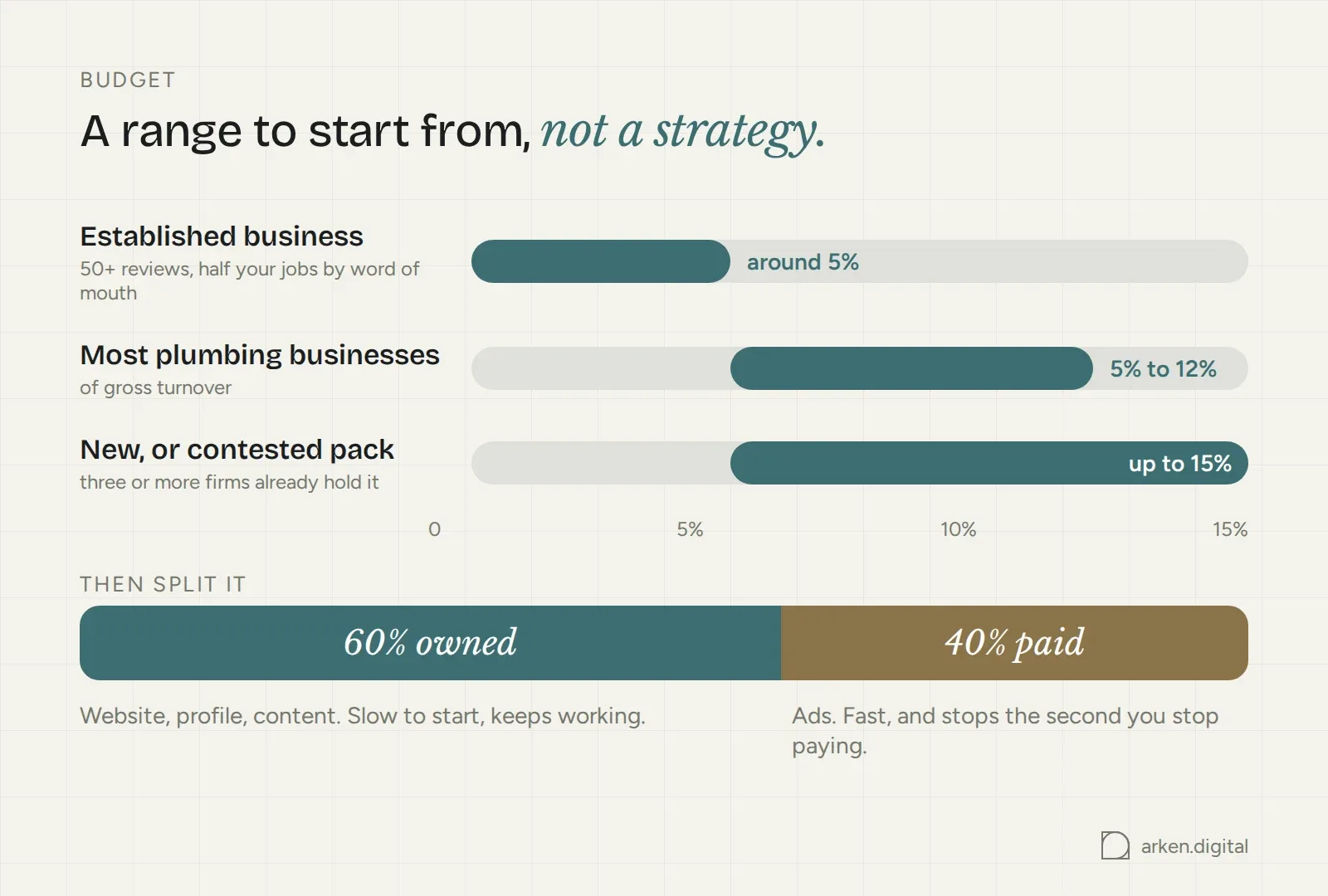
Marketing spend of 5% to 12% of gross turnover is a workable range for a plumbing business. For a new business, or one trying to break into a market where three or more established firms already hold the Map Pack for the main service term, that can rise towards 15%.
Don't treat the percentage as the strategy. What matters is what the money is doing. If referrals already account for around half your monthly jobs and you've got 50 or more Google reviews, spending around 5% and concentrating on your Google Business Profile and review generation gives you a very different starting point from a new plumbing company nobody has heard of yet.
A rough 60/40 split in favour of owned channels gives you somewhere sensible to start. Owned channels are the things you control: your website, your profile and your content. They take three to six months to produce steady enquiries, but they keep working after you've stopped paying for each individual click. Paid channels are faster, but they also stop the second you stop paying. That's why we want both.
Getting found locally: SEO and Google Business Profile
Local search is where most plumbing enquiries start, and the competition is usually much smaller than people think. You're not trying to beat every plumbing website in Britain. You're trying to beat the plumbers Google considers relevant to the customer searching in your area.
Three things do most of the work: the local SEO fundamentals, your Google Business Profile and the way the website is organised.
Local SEO fundamentals
Google states that local rankings are based on relevance, distance and prominence. Relevance is whether your business matches what somebody searched for. Distance is where you are in relation to the searcher. Prominence is how established and trusted Google believes the business to be, using signals including your profile, reviews and mentions elsewhere online.
You can't move your premises every time somebody searches. You can make it extremely clear what you do, where you do it and whether you're a real business worth showing.
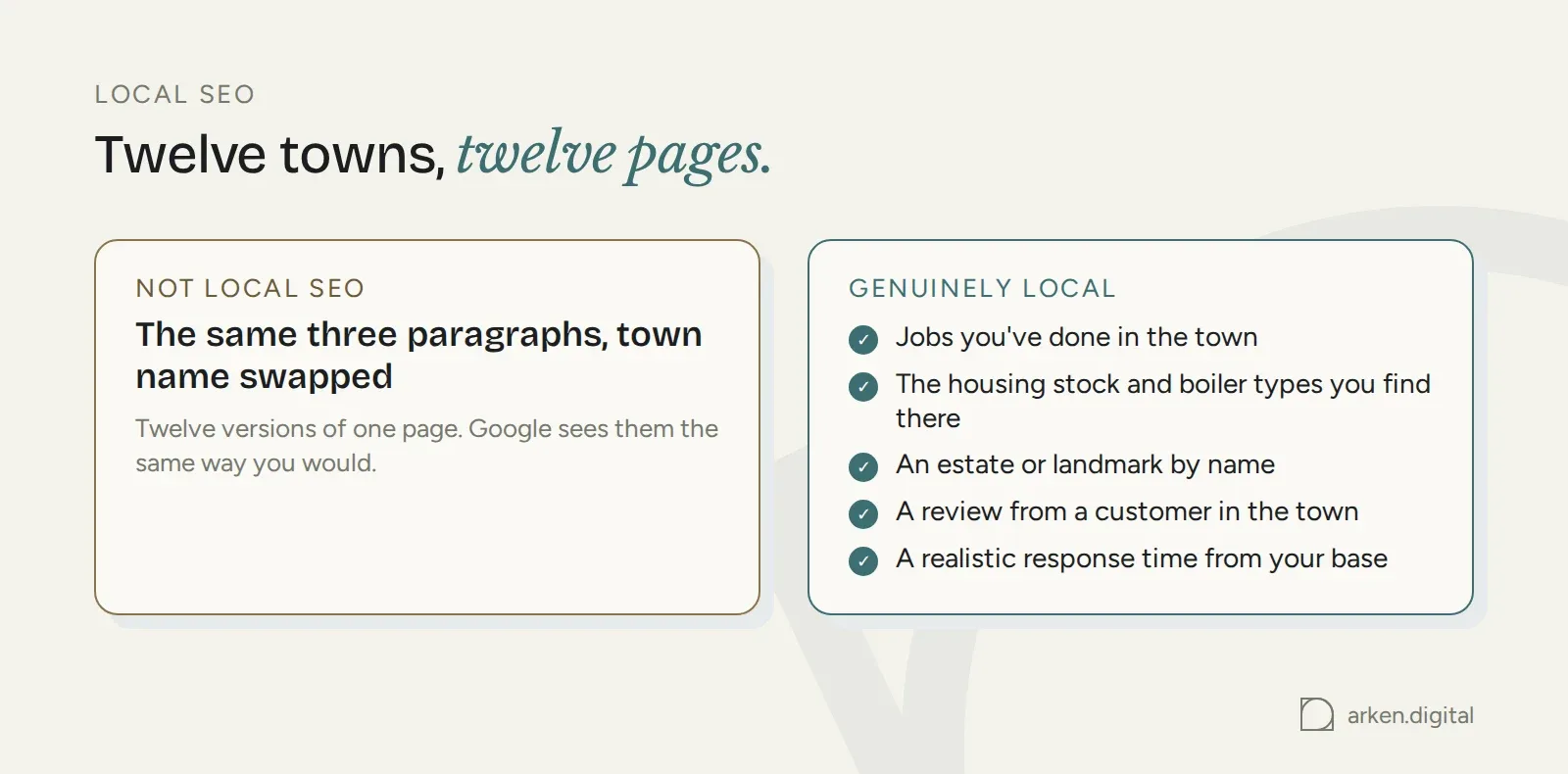
Service-area pages are part of that. "Emergency plumber in Solihull" is a page. "Boiler repair in Solihull" is a different page. Each one needs genuinely unique content. Copying the same three paragraphs across twelve towns and changing the place name isn't local SEO, it's twelve versions of the same page.
Use things that actually belong to the area: jobs you've done there, the housing stock and boiler types you come across, an estate or landmark by name, a review from a customer in the town, and a realistic response time from where you're based. That's what makes the page local.
Optimising your Google Business Profile
Claiming the profile is step one. It's not the job finished. A profile with no recent photos and opening hours that haven't been checked in two years looks abandoned to the customer reading it.
Post to it about once a week. A short update about a completed job, a seasonal reminder or a note about bank holiday availability is enough. Posts give people reading the listing something current to see, though local ranking itself still comes back to relevance, distance and prominence.
Set the categories properly. Plumber should be the primary category, with secondary categories covering services you genuinely offer. If you travel to customers rather than serving them at a premises, set your service areas correctly and make sure they line up with the towns you're actually targeting on the website.
And use real photos: your van, your team, completed installations, a boiler swap halfway through, the finished bathroom. Stock photography tells somebody what a plumber looks like. They already know.
Site architecture
Group pages by service and location in a hierarchy that makes sense. A customer and a search crawler should both be able to reach the right page within two clicks of the homepage.
A services hub can link to boiler repair, bathroom installation, emergency callouts and drainage, with each service linking through to its relevant location pages. An areas-covered hub can link to each town you serve. Then connect the pages properly. Your Coventry boiler repair page should link back to your main boiler repair page and to your Coventry hub.
Don't leave orphan pages sitting around with nothing else on the site linking to them. They get crawled rarely and rank poorly.
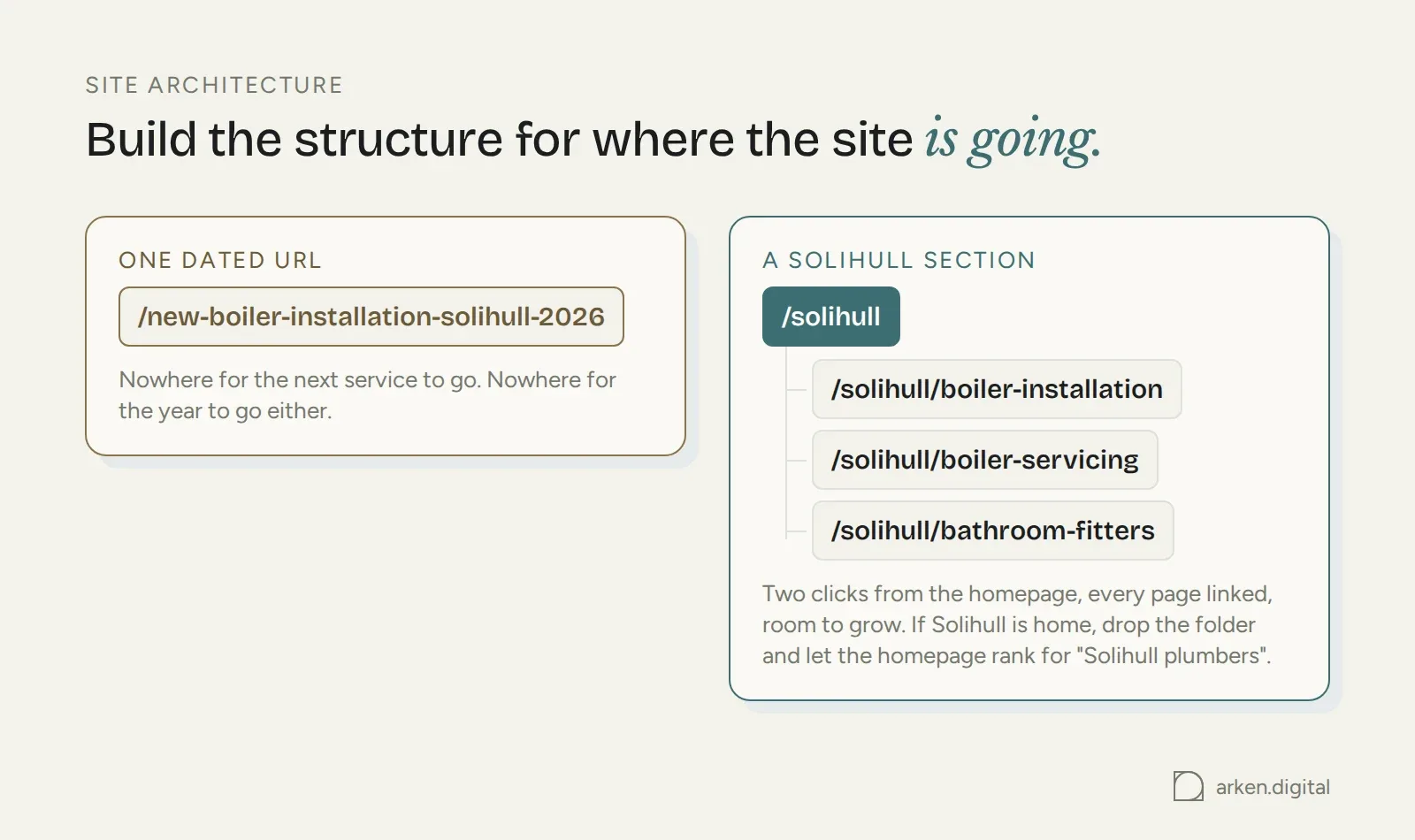
Keep the URLs readable too. `/boiler-repair/coventry` is better than a string of numbers. Avoid URLs like:
`example.co.uk/new-boiler-installation-solihull-2026`
If Solihull is one of several locations you serve, structure it properly:
`example.co.uk/solihull/boiler-installation`
That gives you room for other services inside the same Solihull section:
`example.co.uk/solihull/boiler-servicing/`
`example.co.uk/solihull/bathroom-fitters/`
If Solihull is your main location, drop the Solihull subfolder. Typically, we'd rank the homepage for the seed terms such as "Solihull plumbers."
Build the structure for where the website is going, not just the five pages it has today.
Attracting customers: paid advertising and lead generation
Paid advertising gets enquiries moving quickly, which is useful when the SEO work hasn't had time to produce a steady flow yet. But clicks aren't the objective, and calls aren't even the objective. Booked jobs are.
Google Ads and PPC for plumbers
Bid on transactional, location-specific terms. "Emergency plumber Leeds" and "boiler repair near me" have somebody looking for a plumber behind them. "How to fix a dripping tap" has somebody looking for instructions. Don't pay for the second person and then wonder why the campaign isn't making money.
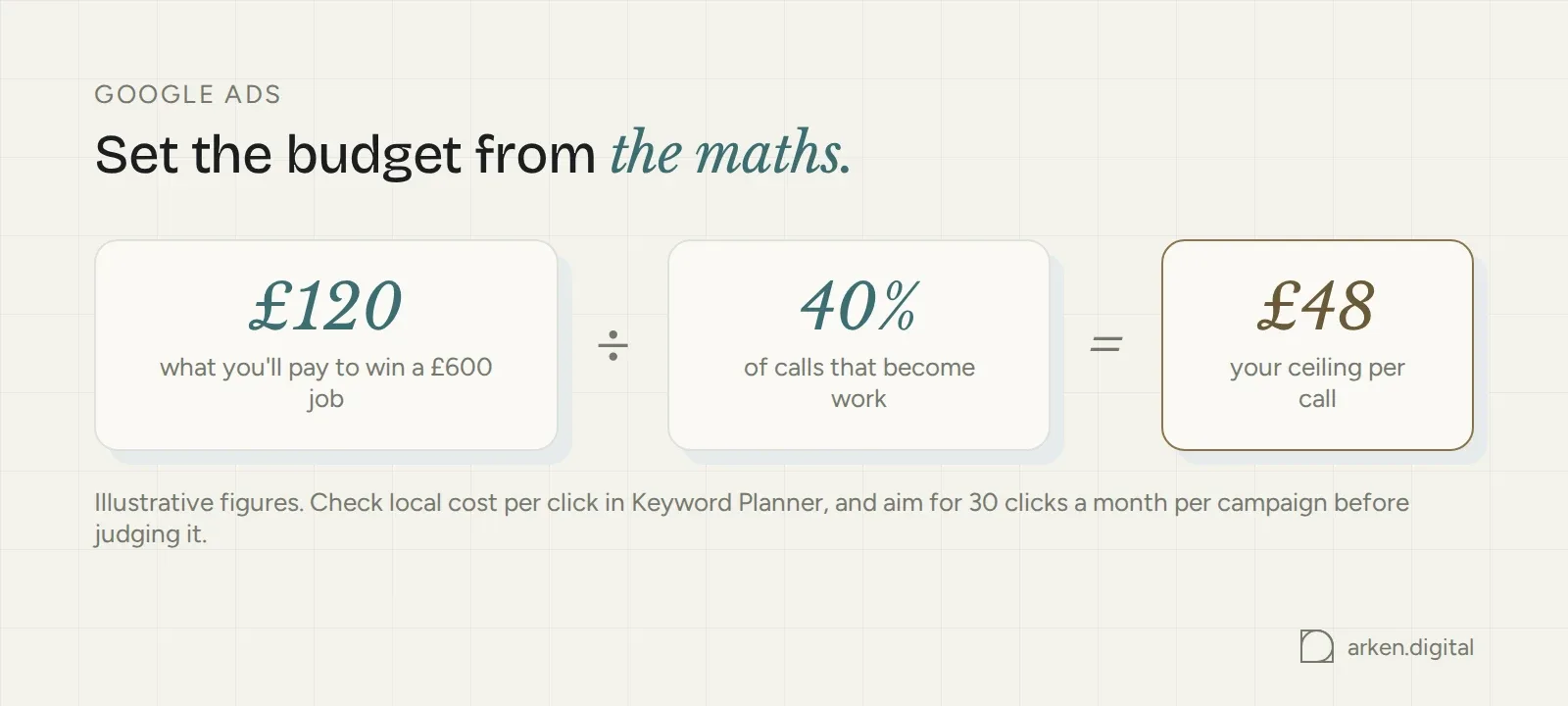
Set the budget from the maths rather than picking a nice round number. Start with your average job value. Decide what you can afford to pay to win that job. Then divide that by the percentage of calls that actually turn into work. That gives you your ceiling on cost per call.
Check the local cost per click for your main terms in Google Ads Keyword Planner before committing the budget, and aim for at least 30 clicks a month per campaign. Below that, you don't have enough data to judge much.
And don't send paid traffic to a generic homepage. Send it to a landing page built around the thing the person searched for: one service, one phone number, one form.
Emergency campaigns benefit from dayparting. Concentrate spend on evenings, weekends and cold snaps, when the problem is genuinely urgent and people will pay for speed. Call-only ads suit those searches because the person wants a plumber, not fifteen minutes browsing your website.
Then judge the campaign on cost per booked job. Cost per click tells you what Google charged you. It doesn't tell you whether you made any money.
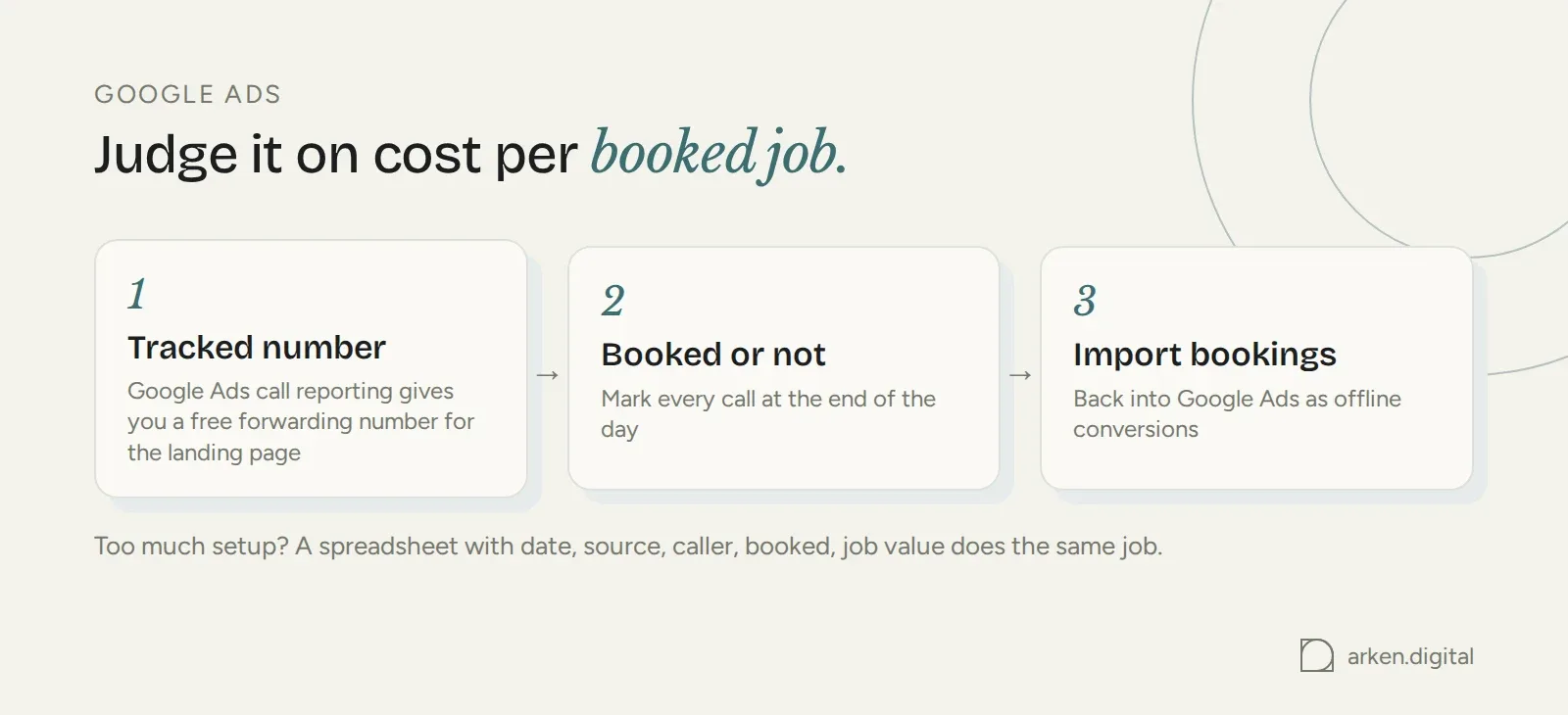
Tracking that takes three steps: put a tracked number on the landing page (Google Ads call reporting provides a free forwarding number), mark each call as booked or not booked at the end of the day, then import the bookings back into Google Ads as offline conversions.
If that's more setup than you want, use a spreadsheet: date, source, caller, booked yes or no, job value. That's enough to tell you which campaigns are putting work in the diary.
Content and channel strategy
Content keeps the business visible between jobs, but you don't need to turn yourself into a full-time content creator. Choose channels that suit the work you want, pick a schedule you can actually maintain, then keep showing up.
Social channels and email
For most plumbers, Facebook and Instagram are proof that the business is real, active and doing good work. Post job photos, short clips of a finished installation, a quick explanation of a repair that wasn't as straightforward as it looked, and reply to the comments yourself.
In our experience, a straightforward phone photo of a new boiler with a sentence explaining what was wrong with the old one gets more engagement than a highly produced brand post. It's also much easier to produce.
Search questions can become content too. "Why is my boiler making a banging noise?" gets searched thousands of times a month. Answer it properly. Do the same with questions such as "how much does a bathroom installation cost in the UK?" Now you've got something useful for the website that can also be repurposed elsewhere.
Email is for keeping past customers warm. A seasonal reminder to book a boiler service before winter can turn an existing customer into a repeat booking, and that's far cheaper than winning them again from scratch. Two or three sends a year is plenty.
LinkedIn only makes sense if you're chasing commercial or B2B contracts. If you mainly want residential plumbing jobs, it's a poor use of your time.
Consistency matters more than production quality. A simple feed that's updated every week beats a polished one that disappears for three months.
Video marketing that works
Plumbing works well on video because people can actually see what you've done. A 30-second clip of a descaled heat exchanger can explain more than three paragraphs.
Film it on your phone. Before and after, a quick explanation of what failed, what you did, what it cost to put right.
Useful formats include common fault diagnosis, a walkthrough of a completed bathroom, a two-minute guide to finding your stopcock, and an honest answer to a pricing question. Then reuse it. Put the same clip on Facebook, Instagram and the relevant service page. That's one piece of content doing three jobs, the three-channel cadence in practice.
Put a named person on camera, usually the owner. Use the same face across the videos, profile photos and website About page. People remember people far more easily than they remember plumbing company logos.
And once somebody has already watched you talk through a couple of boiler problems before they need one fixed themselves, they're not ringing a completely unknown business anymore. That recognition massively helps conversion.
Leveraging reviews and testimonials
Reviews feed trust and local ranking, so collection needs to be routine.
Ask at handover while the customer is happy and the work is fresh. Send a direct link to the Google review form by text before you leave the driveway. Make it easy.
Don't offer customers discounts or payment for reviews. Google's content policies prohibit incentivised and fake reviews, and putting the profile at risk to manufacture a few extra stars is a terrible trade.
Respond to every review, good or bad. Then use the strongest genuine reviews elsewhere. Put them on the homepage and relevant service landing pages, with a first name and town where you have permission and the information available.
Converting prospects into customers
Getting the enquiry is half the job. Turning it into work comes down to speed and how easy you've made the next step.
Response time beats almost everything else here. A missed call or a reply the next morning usually means the job went to whoever answered first. If you can't answer while you're working, use an answering service or call diversion. Voicemail loses work.
Give people several sensible ways to contact you. Phone, web form, text and social DM all get used, and the right one depends on the job. A burst pipe means a phone call; a bathroom quote might start with a Facebook message at 10pm.
Give every core service its own landing page with one obvious call to action. Sending all your traffic to a generic homepage asks the visitor to work out where to go next, and some won't bother.
Keep referral and repeat business alongside the digital leads too. Plenty of jobs start with a Google search and get confirmed when somebody asks a neighbour who they used. The channels support each other.
And keep tracking where enquiries actually come from. Ask on the form. Ask on the phone. Use call tracking numbers. Then next month's budget goes towards what produced work this month.
Avoiding common pitfalls
Most plumbing marketing mistakes aren't particularly complicated. They're usually basic things that nobody is checking.
Running PPC without knowing which calls became booked jobs makes every budget decision guesswork. You end up funding the campaign that makes the phone ring rather than the one that puts work in the diary.
An incomplete or inactive Google Business Profile costs you twice. Wrong hours, no recent photos and unanswered questions hurt the person deciding whether to call you and give Google a worse picture of the business.
An unanswered negative review sits there telling one side of the story. Reply calmly, deal with the actual issue and remember that every future customer can read the response.
Building a website once and never touching it causes quieter problems. Old service areas, three-year-old photos and a contact form that stopped working six months ago don't announce themselves. They just lose enquiries.
And don't run every channel at once. Choose two you can maintain properly, measure them, and get them producing work. Then add the next one.
I have been doing SEO for twelve years, six of them running client campaigns inside other agencies, and the last six running Arken. I started the company because I was tired of the way small businesses were sold SEO: big retainers, fuzzy deliverables, quarterly reports that explained nothing. Arken is my attempt to do the opposite. Plain English, shown work, honest reporting, steady results. Most of what I publish here is the stuff I wish clients had been told before they hired their last agency: what to ask for, what to refuse, what a useful month looks like. If you have a question about what you just read, send me a message and I will answer it myself.
More from RichardWant Richard to look at your site?
Submit your URL and you will get a 15-minute video walkthrough back. Free, no pitch, no follow-up sequence.
Get your free website review