How to build a digital marketing strategy for your law firm

On this page · 1 of 9 ⌄
- Key takeaways
- Digital marketing channels and tactics for law firms
- SEO, search engine optimisation
- Key principles for law firm marketing
- Budget allocation and ROI
- Tracking what works: metrics and measurement
- Why digital marketing fails for law firms and how to fix it
- In-house versus agency: which is right for you?
- Questions we get from law firms
Digital marketing for a law firm works as a connected set of channels, not a pile of isolated tactics. Most firms need the same core: a clear website, SEO and paid search for visibility, content that shows real expertise, LinkedIn and other networks to feed referrals, and a growing eye on how AI search tools summarise and cite legal content.
The weighting is where things change. Can AI tools like ChatGPT actually generate leads, and is Google Ads worth the cost on legal keywords? The answer depends on where your instructions come from now, what a new client is worth, and whether the rest of your marketing can turn that visibility into work.
Key takeaways
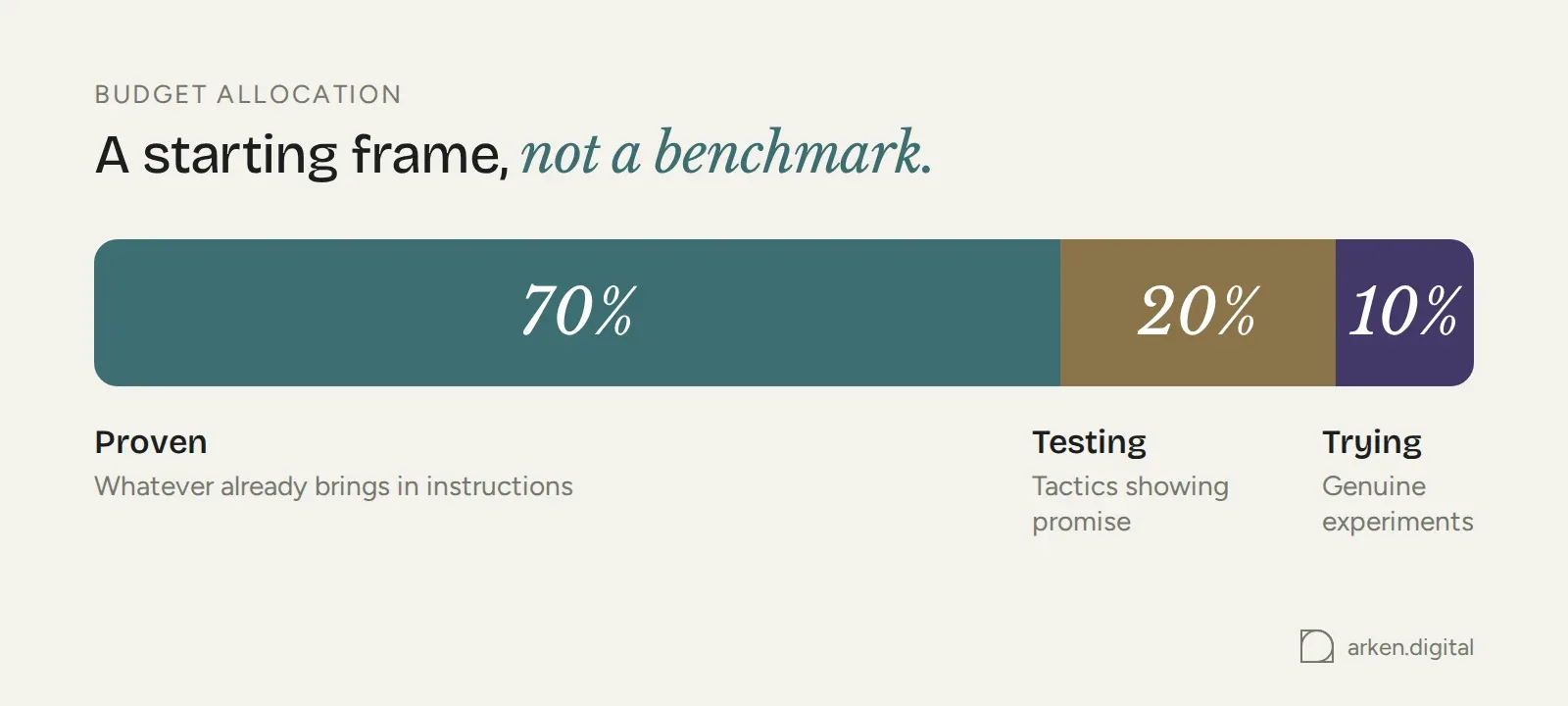
- Split your spend with a budgeting heuristic borrowed from consumer marketing: 70% to what already brings in work, 20% to tactics you're testing, and 10% to genuine experiments. It's a starting frame, not a legal-sector benchmark. The 70% belongs to whichever channel already produces instructions.
- Work out client acquisition cost as total marketing spend divided by the number of new instructed clients in the period, then judge it against the average value of a matter rather than against enquiry volume.
- For location-led work like high street conveyancing or family law, Google ranks local results on relevance, distance and prominence. Reviews feed prominence, so your Google Business Profile and review count are assets worth working on.
- Treat AI search visibility in ChatGPT, Gemini and Claude as a channel to monitor. The fundamentals overlap heavily with good SEO, and reliable prompt tracking is still difficult.
Digital marketing channels and tactics for law firms
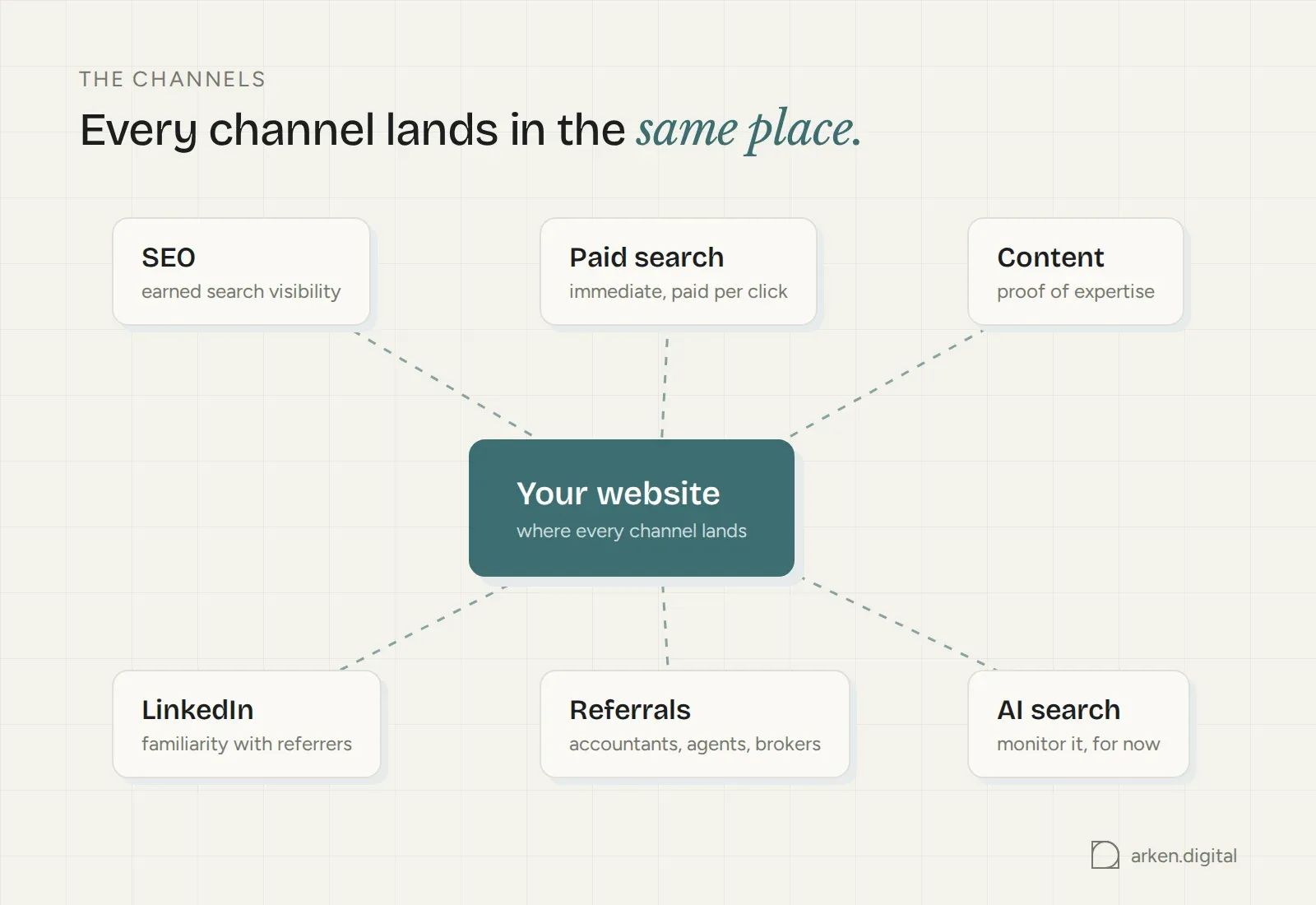
Most firms end up with a similar shortlist: a website that converts, search visibility through SEO and ads, content that proves you know the law, and a professional network that feeds referrals. What changes from firm to firm is the weighting. That comes down to practice area and where your instructions actually come from today.
Your website and client experience
Your website is where every other channel lands. Ads, search results, LinkedIn posts and referrer recommendations all end up at the same place, so it needs to make the next step obvious.
Performance matters, but there's a point of diminishing returns. Google's Core Web Vitals measure how quickly the main content loads, how fast the page responds to a tap, and whether the layout jumps around while it's loading. Google also indexes the mobile version of your site first, so mobile performance is the one to watch.
That doesn't mean shaving another fraction of a second off an already decent website should automatically be a priority. If the site loads at a reasonable speed and doesn't give visitors a poor experience, the bigger question is whether it helps the right people take the next step.
Give them an obvious route to make contact: a visible phone number, a short form, and a clear statement of which offices cover which areas. If your marketing generates the right enquiries but the website makes it difficult to get in touch, that's where the money starts going to waste.
Search engine optimisation and paid search
SEO and paid search both put you in front of people who are actively looking for a solicitor. The difference is what you pay with.
With SEO, you earn the clicks, but they aren't free. You're paying in the work it takes to build and hold visibility. With PPC, you're paying in pounds per click.
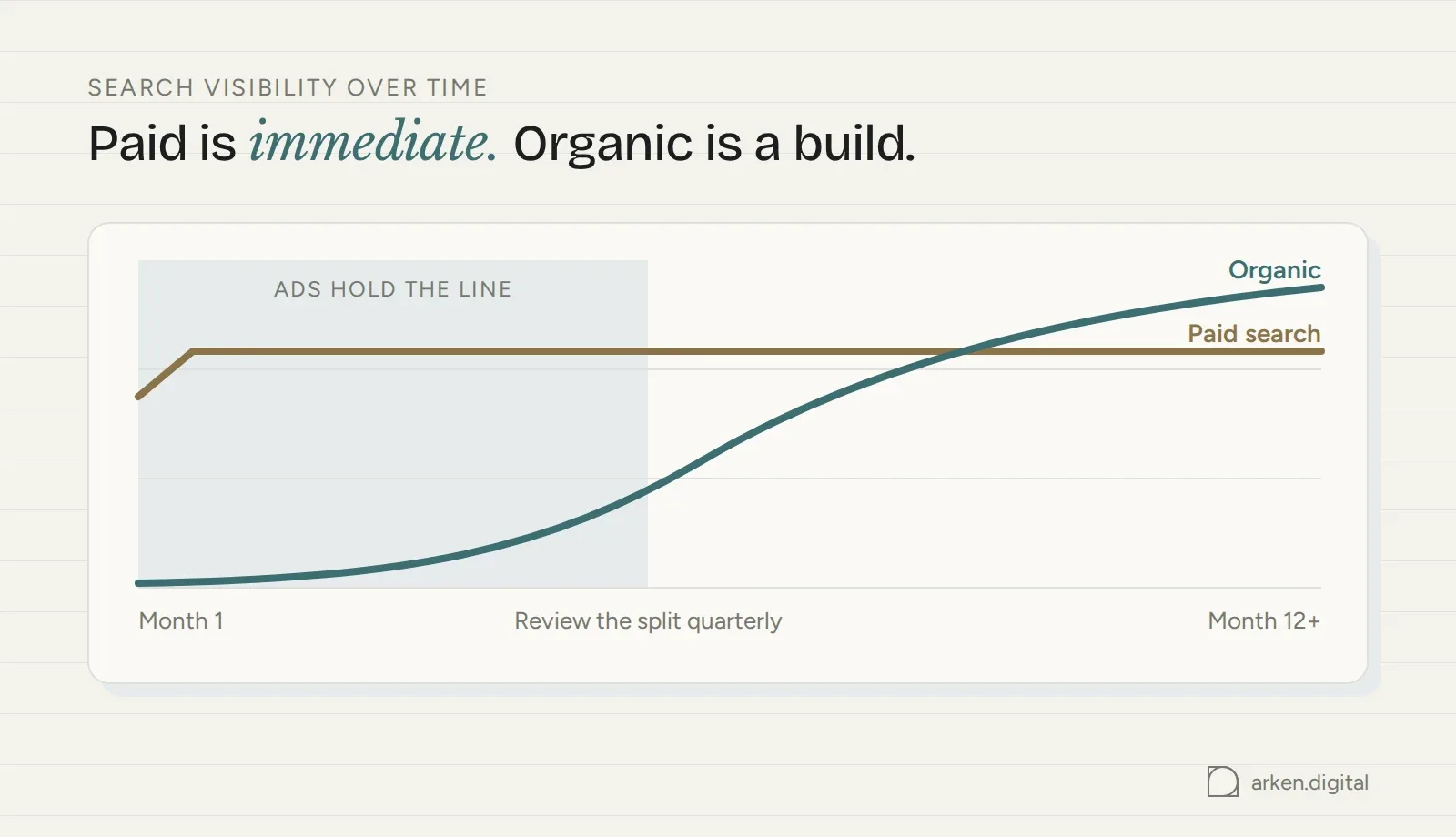
They also work at different speeds. SEO is the longer build: service pages, location pages and links that accumulate over months. Paid search puts you in front of potential clients immediately, which is what makes it useful for practice areas where someone has an urgent problem or a deadline. Conveyancing quotes, employment disputes and personal injury all behave that way.
Run together, the two feed each other. Ads surface conversion data faster than SEO, but keyword-level instruction data only becomes useful once enough conversions sit behind it. Treat 30 conversions in a keyword group as the point at which the numbers are worth acting on; low-volume practice areas may only get a reliable signal at campaign or service level.
There's a sequencing point too. If your organic presence is thin, ads can hold the line while SEO catches up. Run them as a bridge while you build organic visibility, then review the split quarterly against CAC by channel rather than assuming you'll need the same paid budget forever.
Cost per click on legal terms varies a lot by practice area, from niche commercial work up into the tens of pounds for personal injury in competitive city markets. Full ranges are under paid channel costs, below.
Content and thought leadership
Content substantiates expertise once a referral, search or shortlist has put you in the running. A corporate, employment or commercial property team competing for instructions from businesses has to demonstrate that expertise at a distance, and publishing gives it somewhere to live.
For those teams, useful formats include case commentary, practice notes on regulatory changes, and guides aimed at a specific role. A briefing on what a new statutory duty means for HR directors targets a lower-volume, higher-intent query than a general article about employment law. Expect less traffic, but the people reading it have a more specific reason for being there.
Consumer-facing practices need something different: plain-English answers to the questions people actually ask on a first call. How long probate takes. What happens at a first hearing. What a fee estimate covers.
Email fits here too. A newsletter to existing clients, former clients and referrers keeps you in mind when work comes up. The list comes from relationships you already have, so it can't generate new contacts on its own.
You don't need a separate content strategy for every platform. One piece of real expertise can be adapted across the website, email and LinkedIn. More on that below.
Social media and professional networks
SEO and PPC catch people while they're actively searching for a solicitor. LinkedIn, email and other social channels work earlier. They make the name familiar, so when someone eventually needs a solicitor, or gets asked for a recommendation, yours is the one they think of.
LinkedIn matters particularly for firms whose work arrives through other professionals. Accountants, IFAs, estate agents, insurance brokers and HR consultants all refer work, and they're reachable there.
Fee earners posting under their own names tend to get more traction than a firm page. Commentary on a judgment, a note on a deal completing, or a short answer to a question a client asked that week gives people something useful to associate with the name.
Consumer practices can get more from local community presence, including local Facebook groups where people ask for recommendations by name.
Consistency beats trying to be everywhere. Pick the networks your referrers and clients actually use, publish useful material there, and keep doing it.
Optimising for AI search and generative search results
AEO and GEO get talked about as new disciplines sitting alongside SEO. They aren't. Good SEO is AEO and GEO. The fundamentals do almost all of the work needed to become visible in AI-generated answers.
AI search tools summarise information and cite sources rather than simply presenting ten blue links. No AI provider publishes a reliable formula for getting cited, and Google's own guidance on its AI search features says there is no separate optimisation required beyond standard Search best practice.
So start with the fundamentals. Make it unambiguous who the firm is, what it does and where it operates. Keep the firm name, address and phone number consistent wherever they appear online, including directories and your Google Business Profile. Structure content so a direct question gets a direct answer. Attach named authors with genuine credentials to legal content rather than publishing everything anonymously.
Being cited elsewhere is worth pursuing on its own terms too: coverage in trade press, and entries in Chambers and Partners, the Legal 500 and the Law Society's Find a Solicitor.
There isn't yet a good, reliable, affordable way to track every prompt that could surface your firm. Testing it yourself doesn't solve that cleanly either. Search the same prompt a month apart and the LLM will have tailored the answer to your own history in the meantime, so you're not seeing what a genuine prospect sees. What you can do is watch referral traffic where it's available, keep an eye on bot activity on your important pages, and check whether the pages attracting AI crawlers are the ones you actually want surfaced. Treat AI visibility as part of the wider SEO picture rather than building a separate strategy around a tracking system that doesn't exist yet.
SEO, search engine optimisation
SEO for a law firm has two closely connected jobs. One is getting into the local map results when someone searches for a solicitor near them. The other is ranking the organic pages that describe what you do, including for those same local searches. Reviews support the local side of that picture, which is why they get their own treatment here.
Local SEO: ranking on the map pack
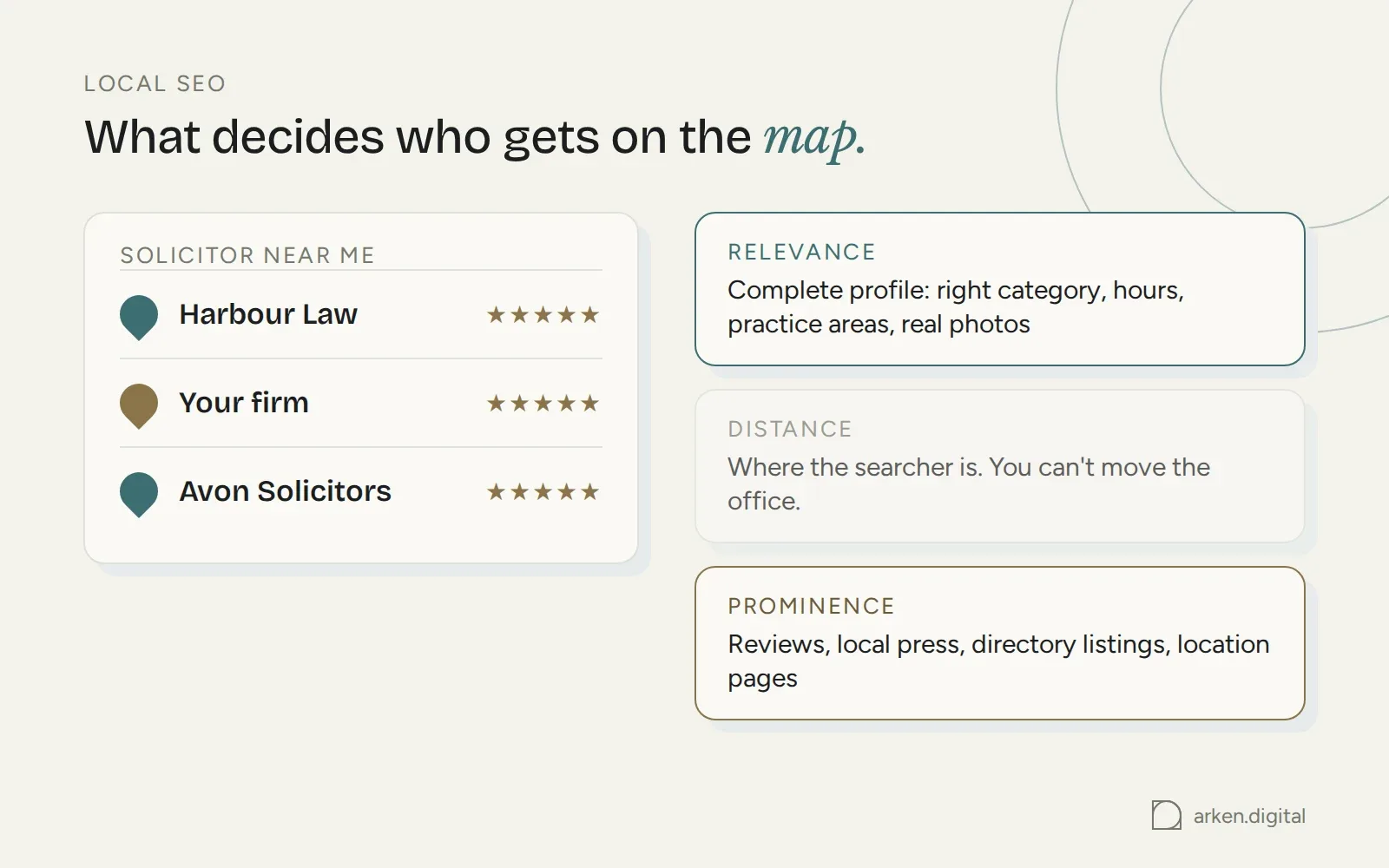
Search "solicitor near me" and a block of business listings appears with a map, commonly three of them on desktop, though the count and where the block sits on the page vary by query. For high street conveyancing, family law, wills and probate, and criminal defence, it's often a valuable position on the page.
Google ranks those listings on relevance, distance and prominence, as set out in its guidance on local ranking. You can't move your office closer to the searcher, so the work goes into the other two.
Relevance comes from a complete Google Business Profile: the right primary category, accurate opening hours, the practice areas you actually offer, photos of the real office, and service areas where you visit clients rather than see them in.
Prominence comes from everything else Google knows about you: reviews, mentions in local press, consistent listings in legal directories, and a website with proper location pages behind it.
Multi-office firms need a separate profile and a separate page per office, each with its own address, phone number and named contacts. Duplicating one page across five towns wastes the effort.
Traditional SEO
The organic side is built on service pages that match how people search, location pages for each office, and links earned from other sites over time.
Local SEO doesn't stop at the map pack, either. You still want to appear in the organic results underneath it for localised searches. A blended campaign works on both, rather than choosing between map visibility and traditional organic rankings.
One page per service, written properly, beats a single "our services" page listing fourteen practice areas. Someone searching for a settlement agreement solicitor should land on a page about settlement agreements.
Links are the slow part. Directory entries, professional bodies, chamber of commerce listings, sponsorships and commentary picked up by trade press all count. Expect movement over months, not weeks, so SEO is the wrong channel if you need enquiries this quarter.
Ahrefs, SEMrush and Moz Pro are commonly used to track keyword positions and backlink health.
Managing online reviews and client testimonials
Reviews do two jobs at once. They feed prominence in the map pack, and they're often the last thing a prospective client checks before dialling your number.
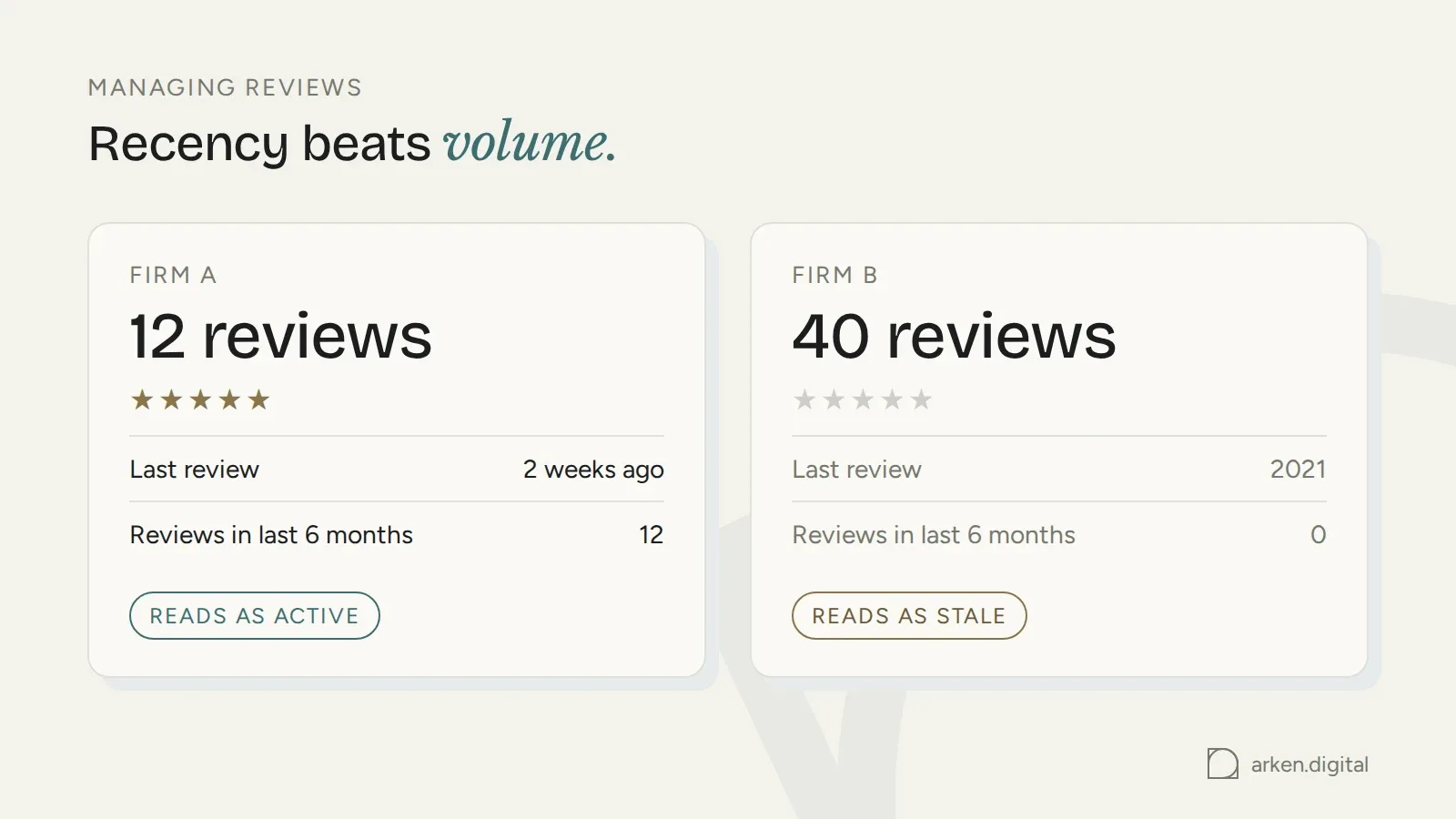
Volume and recency both matter. Twelve reviews from the last six months read better than 40 that stop in 2021, because a stale profile suggests nobody has asked recently.
Ask as a routine step at file closure, with a direct link to the profile. Don't offer anything in return: Google's review content policies prohibit incentivised reviews, and it puts you on the wrong side of professional expectations too.
Replies are worth the five minutes. A short, plain thank-you on the good ones and a measured response on the poor ones shows the firm is paying attention.
Confidentiality still applies. Never confirm or discuss a client's matter in a public reply, even when the review already has. Keep the response to process and an offer to talk offline.
Testimonials on your own site are useful alongside reviews, but they carry the same substantiation requirement as any other claim you publish. That constraint is covered under compliance.
Key principles for law firm marketing
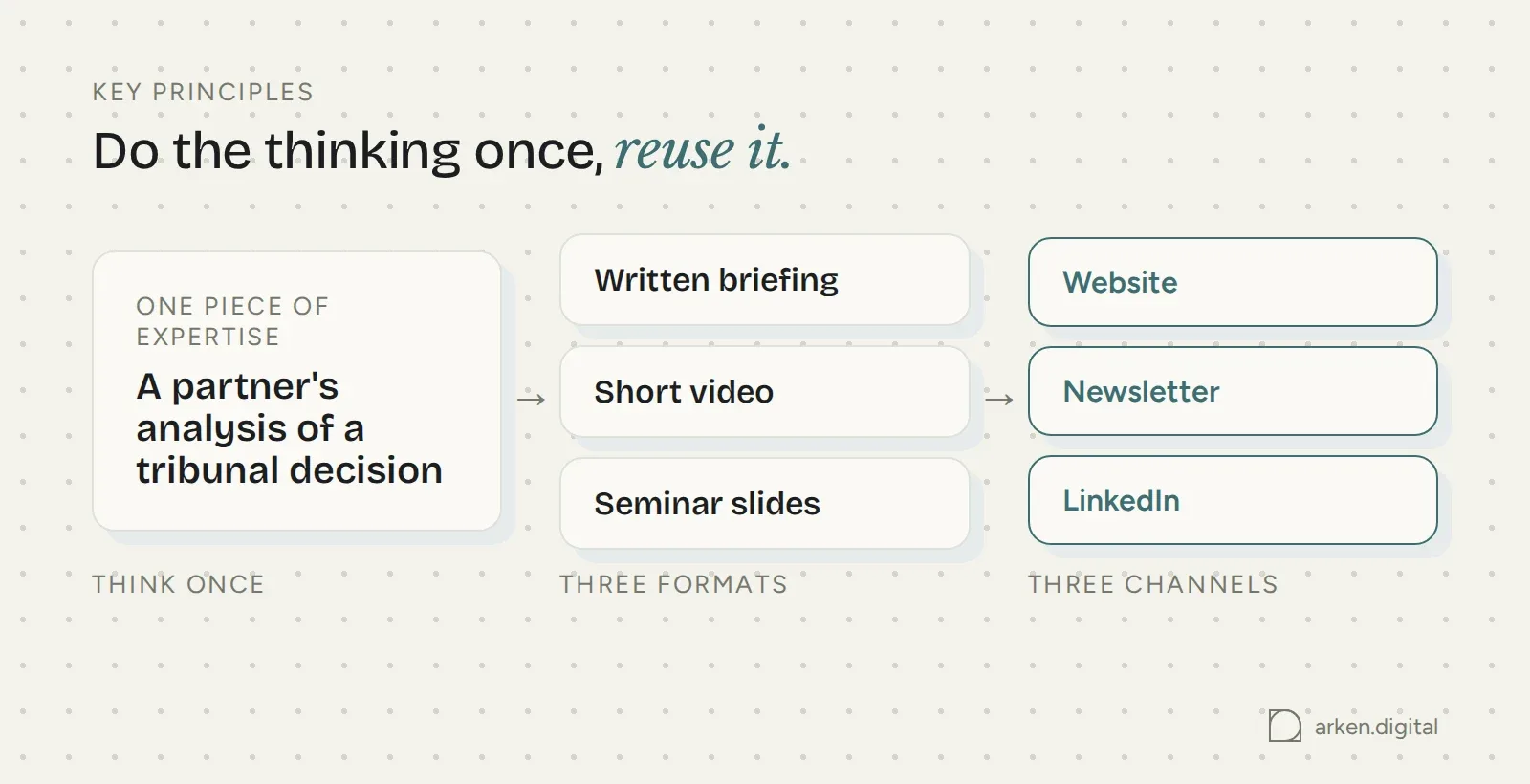
The easiest way for law firm marketing to sprawl is to treat every channel as a separate content machine. It isn't. The same piece of useful expertise can do several jobs, while the budget stays focused on the channels that actually produce work.
Repurposing: three formats, three channels
Take one piece of genuine expertise and adapt it to the formats and channels where your audience will actually see it.
A partner's analysis of a tribunal decision could become a written briefing, a short video and a set of slides for a client seminar. The briefing lives on the website and feeds the newsletter. The video goes on the website and LinkedIn. Useful extracts from either become social posts.
The point isn't to force every idea into exactly three formats. It's to stop building every channel from scratch. If you've already done the thinking, reuse it. Change the presentation to fit the platform without inventing a completely separate strategy behind it.
Referral networks and strategic networking
Referrals remain a distinct channel, and the cost usually sits in fee earner time rather than media spend, which tends to keep the CAC low. Accountants, agents, brokers, other firms and former clients all send work if they remember you.
It sits alongside digital activity rather than under it. Networking gets you known; the website, LinkedIn profile and reviews are what the referrer's contact checks before they ring.
Track it like any other channel, costing the time in. If you don't record where an enquiry came from, referrals quietly look free and get neglected.
Budget allocation and ROI
There's no standard budget figure, because the right number depends on what your average matter is worth and how contested your keywords are. For a starting anchor, take 2% to 5% of your target fee income, with the higher end for firms trying to grow rather than hold position. Set the split by method and measure it properly from the first month.
Measuring ROI and client acquisition cost
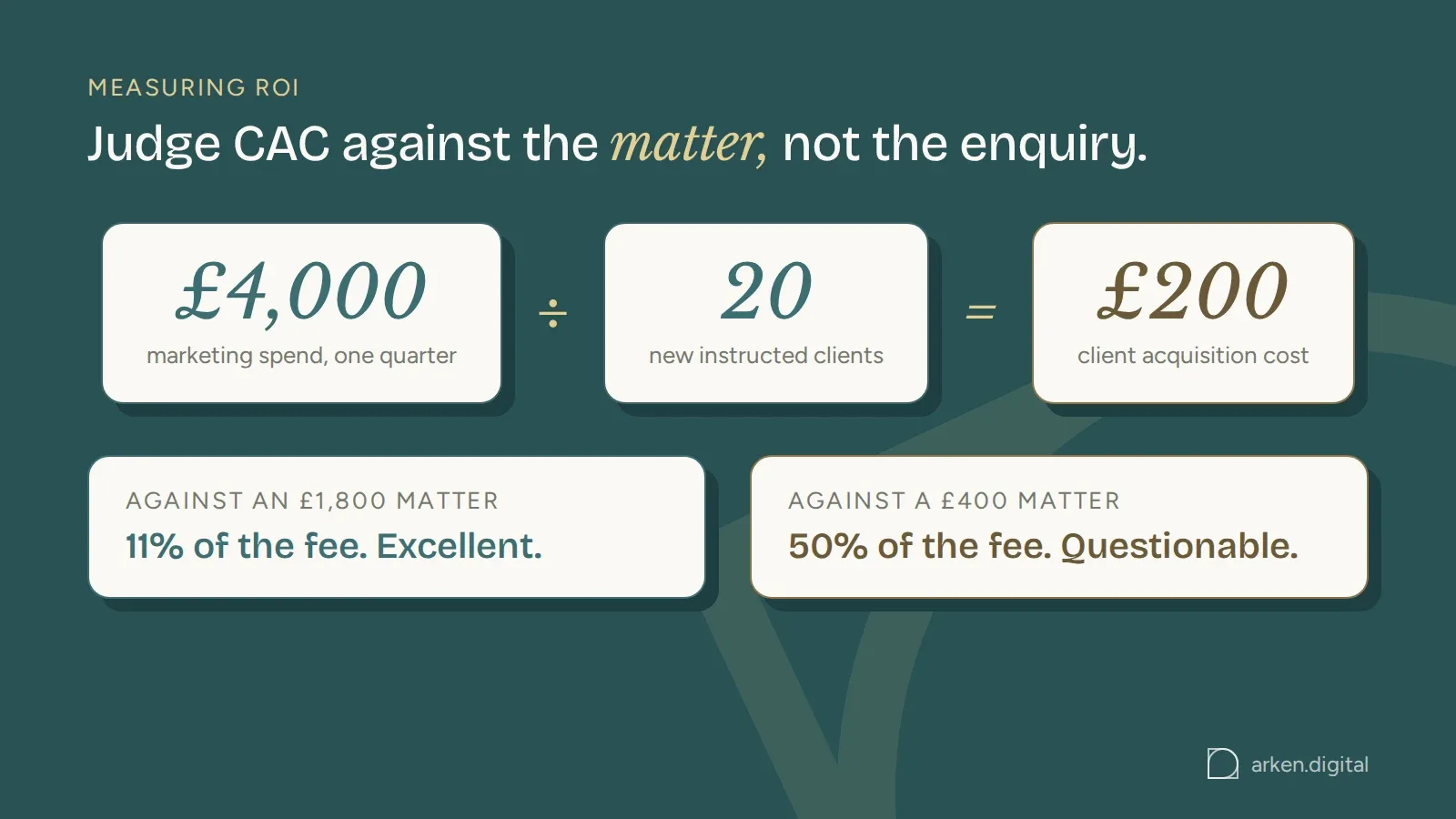
Spend £4,000 in a quarter, instruct 20 new clients, and each one cost you £200. That's your client acquisition cost: total marketing spend for a period divided by the number of new instructed clients from it. Include agency fees, ad spend, tool subscriptions and any internal time you're paying for.
Judge that CAC against the average value of the matter, not against enquiry volume. A £200 CAC is excellent against an £1,800 matter and questionable against a £400 one. Those figures are illustrative. Substitute your own average matter value from your practice management system.
Enquiry counts on their own can mislead badly. A channel can double your enquiries and cut your instructions if those enquiries are outside your practice areas or geographic area. Track CAC per channel and per practice area; blended figures can hide the one campaign that's losing money.
Cost considerations for paid channels
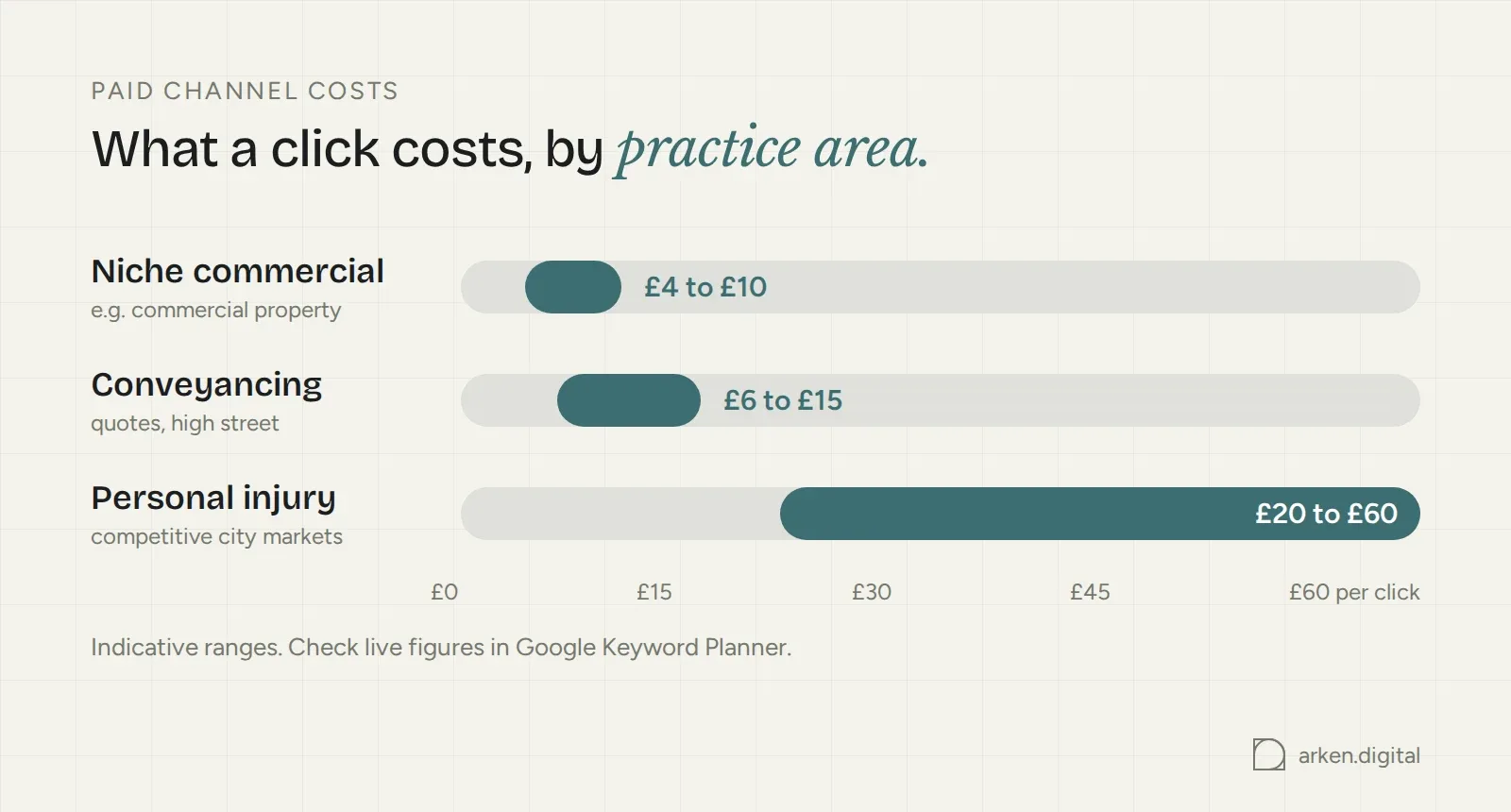
Legal search terms are among the most contested on Google. As indicative ranges, cost per click runs roughly £4 to £10 on niche commercial work, £6 to £15 on conveyancing and £20 to £60 on personal injury, with the top of each range in major cities. Check the live figures for your own terms in Google Keyword Planner before you commit a budget.
Paid search is a perfectly viable strategy. It's an expensive place to discover that the rest of your marketing isn't ready.
Before increasing spend, make sure the website gives people a decent experience, the service and positioning are clear, and the campaign is targeting the kind of clients you actually want. Otherwise, legal PPC can burn through a lot of money without producing the right instructions.
Once those foundations are there, tight match types and negative keywords stop you paying for searches from people looking for free advice, and a landing page built for that specific service, not the homepage, does the rest.
Whether the click price is acceptable comes back to CAC against average matter value. A £30 click isn't automatically expensive if it reliably produces profitable instructions. A £5 click isn't cheap if none of those people become clients.
Tracking what works: metrics and measurement
A minimum set to review monthly:
- Organic traffic, split by landing page
- Keyword positions for your core service and location terms
- Conversion rate on enquiry forms and calls
- Cost per lead by channel
- Client acquisition cost by channel
- Review count and average rating
- Call volume, including missed calls
Missed calls deserve their own line. Plenty of legal enquiries come by phone during working hours, and a call that rings out is a paid-for lead handed to a competitor.
None of those metrics tells you which enquiries became paying clients. For that you need a CRM, or at minimum a shared record where reception and fee earners log the source of every enquiry and what happened to it.
That record is what makes the rest of the data usable. Without it, you know a channel produces enquiries. You still don't know whether it produces work.
Set it up before you increase spend, not after. Retrofitting source data onto six months of enquiries is guesswork, and usually optimistic guesswork.
Review monthly, but judge SEO over quarters. Month-to-month movement in organic traffic tells you very little.
Why digital marketing fails for law firms and how to fix it
Most failures here aren't creative. They're a failure to apply the basics consistently.
Spreading the budget too thinly is the most common one. A small budget divided across five channels buys a little presence everywhere and not enough momentum anywhere; concentrating it on the channels that already show promise gives you something meaningful to measure.
Capacity comes next. SEO and ads generate enquiries, but someone still has to answer them. A reception process that can't absorb the volume burns the spend that created it.
Then there's measurement. With no CAC or conversion tracking, there's no sensible basis for cutting one channel and scaling another. Budgets end up decided by whichever number looks best in a report, or whoever argues hardest for their channel.
Adding source-capture fields to an enquiry log is a job of days. Rebuilding six months of missing attribution isn't.
Compliance and regulatory constraints
The fourth cause is marketing that promises something the firm can't stand behind. That's a regulatory problem before it's a client-expectations one.
The SRA Standards and Regulations require that information a firm publishes about its services is not misleading and can be substantiated. That directly limits how you market outcomes, results and guaranteed fees.
In practice, it rules out a lot of copy that performs well in other industries: success rates you can't evidence, guaranteed results, fixed fees quoted without the exclusions that actually apply, case studies that identify a client who hasn't agreed to it.
You can still market strongly within that. Named specialists with real credentials, clear fee structures with the caveats stated, verifiable experience, and reviews from clients in their own words all substantiate themselves.
Brief whoever writes your copy on this before they start, whether in-house or agency. Retrofitting compliance onto a live campaign is slower and more expensive than building it in.
In-house versus agency: which is right for you?
The choice isn't simply agency retainer versus salary. The useful comparison is what capability you actually get for the total cost.
Pros and cons of in-house teams
Someone in-house learns your practice areas, your voice and your fee earners in a way an external team takes time to match. They're in the building when a case settles and there's something worth publishing.
The limit is breadth. One marketing manager rarely covers technical SEO, paid search, content and web development to a high standard, because those are different specialisms.
There's another limitation worth stating plainly: an in-house marketer works deeply on one firm's campaigns, while an agency team sees a much wider range of them. That range matters when something isn't working and you need to know what to change instead.
When to hire an agency
We're an agency, so there's an obvious bias here. It's worth saying outright rather than pretending otherwise. But for small and medium-sized firms, an agency is usually the better use of the money. Matching that breadth in-house means hiring people good enough to run four specialisms well, and people that good cost more than most agency retainers, not less. An agency's whole model is built around spreading that cost across several clients at once.
SEO, PPC, content and technical work sit in one team, and you buy the amount of each the strategy needs.
Compare the cost properly. In-house means salary, pension, tools like Ahrefs or SEMrush, and partner time spent managing the person. Set that total against the agency retainer, not the salary alone.
That doesn't make in-house the wrong answer. Larger multi-office firms and those with dispersed teams often run a hybrid: an in-house marketing lead owns the strategy, relationships and briefing, with specialist agency support underneath.
Questions we get from law firms
Two questions come up in most planning conversations. Both are really about where to spend money you can only spend once.
Is ChatGPT a good source of leads?
Firms are starting to appear in answers from ChatGPT, Gemini and Claude, so AI search is a real source of visibility. When leads do arrive this way, our experience is that they tend to be more pre-qualified. Someone using an AI chatbot can have a longer conversation, explain the problem and narrow things down before a particular firm surfaces, rather than typing a few keywords and clicking a result the way they would on Google.
That doesn't make AI search a channel to build the year's lead target around. Volumes are still low next to Google, and attribution is difficult because there isn't always a clean click to track.
The work is still worth doing because it overlaps so heavily with good SEO: clear information about the firm, useful content that answers specific questions, and consistent details across the web. Monitor AI visibility. Don't build a separate strategy around it.
Are Google Ads too expensive?
Legal keywords can be expensive, and if your firm hasn't invested seriously in marketing before, PPC usually isn't the place to start. Mistakes cost money immediately: if the website isn't converting, the targeting is loose, or the language attracts the wrong kind of enquiry, Google Ads will burn through budget while you're still figuring out the basics.
Once those foundations are in place, paid search is a perfectly viable channel. Whether it's expensive comes down to the value of the clients it wins, not the headline cost per click.
Work it in two stages: clicks to enquiries, then enquiries to instructions. On illustrative figures, if 15 clicks at £14 produce one instructed client, that's £210 to win a £2,000 matter. Substitute your own measured rates at both stages. The combined rate is what decides whether Google Ads is expensive for your firm.
I have been doing SEO for twelve years, six of them running client campaigns inside other agencies, and the last six running Arken. I started the company because I was tired of the way small businesses were sold SEO: big retainers, fuzzy deliverables, quarterly reports that explained nothing. Arken is my attempt to do the opposite. Plain English, shown work, honest reporting, steady results. Most of what I publish here is the stuff I wish clients had been told before they hired their last agency: what to ask for, what to refuse, what a useful month looks like. If you have a question about what you just read, send me a message and I will answer it myself.
More from RichardWant Richard to look at your site?
Submit your URL and you will get a 15-minute video walkthrough back. Free, no pitch, no follow-up sequence.
Get your free website review